Advent Calendar, Day 18: Short Stories from Luna Press Publishing
December 18, 2021Day 18 of #SantaBooksInt is here, and we have a wonderful treat from Luna Press: three short stories from three brilliant collections published earlier this year!
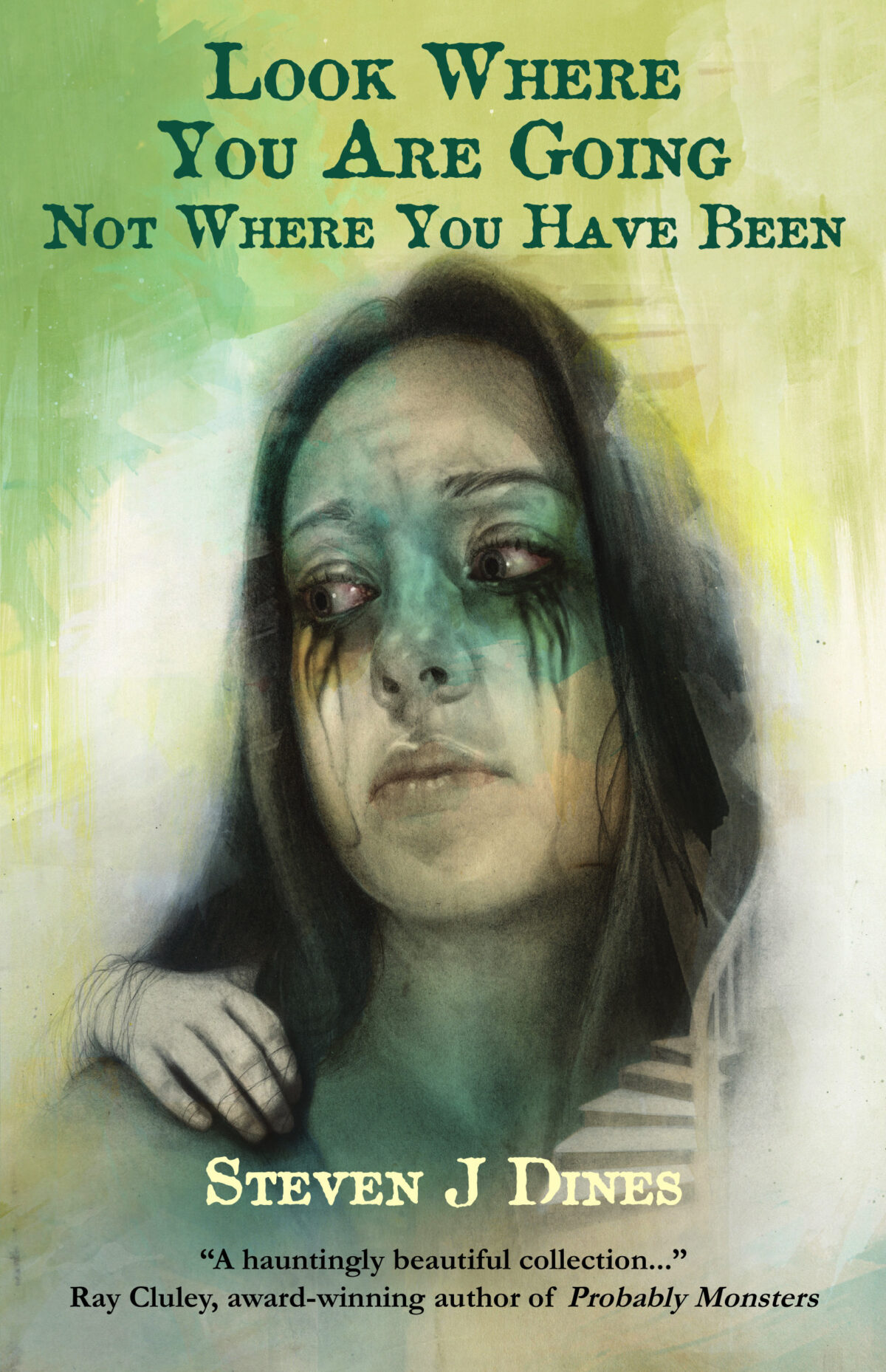
Look Where You Are Going Not Where You Have Been
Publisher: Luna Press Publishing
Publication date: 21 September 2021
ISBN: 9781913387679
Format: Paperback
Extent: 340 pages
The past is never far behind. If we do not leave it, if we insist on carrying it with us to the end… that end is a monster.
This stunning debut collection of dark, literary fiction drowns the reader in its themes of grief, regret, love, and hope. A family is torn apart by tragedy and misadventure, their future creaking under the weight of judgment. Old men play at being ghosts while a young boy sees real ones wherever he turns. A wandering immortal desperately seeks an end to his pain.
Intimate, unflinching, and poignant, these eleven tales of the broken and the unmade include the two previously unpublished novellas, dragonland and This House is Not Haunted.
About the Author
Steven J Dines’ dark literary fiction has been published in numerous magazines and anthologies, including Black Static (nine times), Interzone, Crimewave, Fireside Magazine, Terror Tales of the Home Counties, and Best British Horror. Originally from Aberdeen, Scotland, he currently lives south of the border, in Salisbury, with his wife and two sons.
Short Story
You can read the story below or download it as a PDF.
Pendulum
Swing, says the pendulum.
This was supposed to be my life story. Instead, it’s a tale unfinished, like a son stuck forever in a tilted uterus or some shy performer cowering in the wings with eternal stage fright. But my son arrived—to die, aged nine—following an arduous thirty-hour labour that came to nothing. In the end: ventouse. They sucked him right out of my aforementioned tilt with a bruised shoulder and a head like a football or an alien or an alien football, misshapen as the thoughts that would come to form inside it, that never did get the chance to become shapen, like your thoughts or… like your thoughts.
First we need to go back. I am writing this in stream of consciousness. Connected moments recorded in a continuous flow, one word, one sentence leading naturally to the next. Reducing my life to this.
This sentence.
My obstetrician looked like Steve Buscemi.
But we need to go further back than that. The pendulum swings over the same old ground every time to reach the beginning, to reach the end.
Back.
I went into labour while watching the HBO series, Boardwalk Empire. March 2011 that was. My waters broke, soaked the couch cushions, and to this day the season remains unwatched. Just one odd association in a story littered with them, you’ll find.
Back. Let the pendulum swing all the way to the left.
Waiting. Sickness. Waiting. Cravings. Waiting. Sickness.
Peeing on sticks. A factory of sticks. Until you find the one, the golden ticket after you have already been to the factory so many fucking times.
Sex with Ellis, lots of sex. A factory of sex.
“Let’s try for a baby,” I said.
That was 2010. We were in a children’s play park just off Venice Beach. I was twenty-three, Obama was in the White House, Katy Perry in the charts, telling us about California Gurls even though she was not singing about me. Ellis and I sat on the swings, two adults trying to recapture something, listening to the chains creak under the weight of our years.
“I’ve been thinking about killing myself,” he said. “I’m so depressed. I hate my job. I hate this place. Let’s go someplace else, Milly. Let’s get out of here… I need to talk to you about something.”
It’s funny how, thinking back, Ellis starts with the line about wanting to die, just comes right out with it. Which is different to how it actually played out; the opposite, in fact. He took his time to tell me. Really built up to that shit. But as the pendulum swings back it all looks and sounds and feels so different: you pull the bandage from the wound before the wound is made. It makes it easier somehow. The scabs shrink, disappear, leave the smile of a fresh cut before the blade moves up and across your forearm to close the skin and leave behind the soft, perfect paleness of a blank page. Which is why I never liked tattoos much, because you’re writing a story that can never be unwritten. Who wants that?
The sleeve unrolls down my arm.
And I get to unhate myself for wanting a child. It’s like the tide slipping away from the shore and leaving me with the tiny, broken shells of my life gathered in the crook of my arm. Walking backwards, I get to place them back into their depressions in the sand. Lay them out across a stretch of empty beach.
“I want a baby.”
Then I sit on the sand and wiggle my painted-blued toes as I stare down the retreating waves.
Let’s stop here awhile. Let the pendulum hang for a moment. Let the forces exchange, one become another. Besides, there is no point going any further back than this. There is only the empty air of my life leading up to that day, aged twenty three on the sand. The pendulum can only go so far back before it stops to protect itself. Force it any farther (strange how farther sounds like father, right?) and something breaks. So let’s stop awhile and let the waves stop with us. A perfect pause.
Calm.
Silence.
No friction, no drag.
Silence.
Calm.
Unpause, and the surf rolls toward me, waves rushing in like a bunch of fists at first but losing their power, their hatred, until they are fingers crawling ever-so-timidly across the sand toward the wriggling paintedness of my toes. All froth and foam and not a chance of undertow to drag me down.
“I want a baby.”
I jump up and start combing the beach for shells or anything precious. At first, I pick up the prettiest shells, the smoothest ones, the most-perfect, but soon I am gladly picking up whatever I can find, seeking reassurance from the thing taking shape in the crook of my arm: my shell baby. But then I get spooked and lift my arm and with this foolish notion of having a child with Ellis I let it all fall to the ground like a bunch of collapsing bones. I hate myself for even thinking it, but then those are the ideas that tend to stick sometimes: the ones with barbs.
The sleeve rolls up my arm.
I have locked myself in the bathroom of our Venice Beach apartment. Ellis is in the bedroom playing Xbox, streaming to his building fanbase as he yells his frustration at his teammates and the television screen. The sound of the surf reaches me through the open window, a lulling effect, drowning Ellis. You step outside yourself to remember how daddy used to say it was all your fault. Mommy leaving? Your fault. Losing his job? Your fault. His being stuck in the house, looking after some kid? His kid, your fault. Meanwhile, Ellis rages and curses at the TV screen as you make a fist and take the cuts.
“I need to talk to you about something… Let’s get out of here. Let’s go someplace else, Milly. I hate this place. I hate my job. I’m so depressed. I’ve been thinking about killing myself.”
I had sensed he was building up to something; maybe not that but something. Walking through Venice with Ellis, he took my hand and led me into some children’s play park and sat me on a swing. And I was five-years-old again with my father, begging him to stop pushing the swing so hard and him laughing at my fear. He never hit me but maybe he liked to see me cry. Daddy. Ellis. Daddy with his pushing, Ellis with that way of his, how he built himself up to telling me something big, little pushes of words at first, then harder and harder until the chains went slack and it became less of a swing and more of a series of falls.
“Let’s have a baby,” I say.
Sex with Ellis, lots of sex. A factory of sex. Peeing on sticks. A factory of sticks. Until you find the one, the golden ticket after you’ve already been to the factory so many fucking times.
Sickness. Waiting. Cravings. Waiting. Sickness. Waiting.
My waters break during the seventh episode of season one of Boardwalk Empire. Right there on the couch in our Venice Beach apartment.
You’re in labour but you decide there is time to take a shower and shave your legs while Ellis goes insane with panic. But you’ve got this.
Don’t panic, he says, panicked.
So cute, his male ignorance.
There are some things you love about him.
Hospital labour ward. Pushing for hours. A Buscemi-lookalike obstetrician, a theater with a line of doctors and students observing your distended vagina, and Buscemi peering over the stubborn roundness of your belly, those piercing blue eyes of his tightening with concern. Between the doctors, the nurses, the student doctors, you have never seen so many furrowed brows. Suction, suction, suction, before finally the head, the trapped shoulder come loose, pop loose, and a child is born.
Your child.
Your fault.
Equilibrium.
Staring at his misshapen head, Ellis says, “I think there’s something wrong with it.”
He actually says those words.
I get as far as thinking maybe something isn’t right, before I consign it to exhaustion and the fear of becoming a new mother. But maybe Ellis senses something that I cannot. That happiness is merely dancing in the cemetery. Flossing on someone else’s grave.
“Maybe there’s something wrong with you,” I tell him.
Swing, says the pendulum.
Swing, says the axe.
Ellis does not argue but begins to let his absences speak on his behalf. Plugs himself into his fanbase and unplugs himself from us. And when he leaves, when he finally builds himself up to telling me he is leaving, the silence that remains feels like the sum total of all the arguments we’ve never had.
So infuriating, his male ignorance.
Jack is a good boy. Too good. Maybe that should be the loudest alarm bell but he is my firstborn and so my only point of reference.
As a baby there are tears but not a lot.
At two, three, four years old, there are words but, again, not a lot.
In kindergarten, he plays on his own in the sandpit or finds a quiet spot and builds towers with wooden blocks. Not towers, not really: they are Jenga blocks stacked end to end on top of each other, thin, frail structures with weak foundations, destined to fall when they reach a certain height.
I see nothing wrong with it. He builds those towers higher than anyone else in his class, and that makes mommy proud. But I mistake ambition and drive for what is really Jack’s simple need for order, structure, repetition.
I start to become more… erratic, which is a soft way of saying I am a fucking mess. I miss Ellis, I hate Ellis, I miss Ellis. Back and forth.
Son of a bitch.
We see him on the beach sometimes, taking time out from Call of Duty. Jack is oblivious to his sperm donor being out there (I call Ellis that because he is no father to Jack; where is that call of duty?). We will be walking along the boardwalk, watching the street performers, Jack alongside me with one of his Jenga blocks clutched in his hand, and then I’ll spot Ellis sitting not so far out on the sand that he could not see us if he just lay down his guitar and turned his head. But he never does. He is usually with a different gamer girl every time: thin girls with big chests, bright hair, tattoos, piercings.
That used to be me, I think, except for the tattoos. Now my tits are deflated, the dye long washed out of my hair, the holes closed and healed over but for the scars. Still, it’s hard to see different versions of yourself out there having fun.
Living.
We usually stop at Zelda’s Delicatessen for mini-donuts, although on the days I see Ellis I cannot eat, so we get them to go and head back to our apartment where I sit on the couch and smoke a joint as Jack eats a cinnamon sugar and adds to his latest tower. Both of us chasing our high.
“Mom? What was the man playing?” he asks me one time. The only time.
“What man?”
“The guitar man on the sand,” he says. “He had a pink girlfriend. She had drawings on her neck.”
He means pink-haired and neck tattoos and holy shit he means Ellis. His—
“Why do you wanna know?” I ask, trying not to sound defensive but sounding precisely that.
“I liked it.”
“So now what? You wanna meet him? You wanna meet the guitar man and, and—what?—become his friend?”
“No…”
“Then what do you want, Jack? Because I can tell you something: the guitar man doesn’t want to meet you.” I stop, put my head in my hands. “Sorry. I didn’t mean… I’m, sorry. Okay?”
Jack nods but he looks hurt in the way he always looks hurt. Like he’s just swallowed a hot chip and he’s trying to hold it together.
One too many tokes for me, I’m afraid. Rolling the j, I had been thinking of Ms Neck Tattoo, about the naked branches reaching up from her collar, of the trunk down the centre of her back, of the roots perhaps spreading across the skinny white cheeks of her ass, of Ellis’s hands foraging around in the dirt down there, foraging around in the moist, dark dirt… Really, I just want to forget what happened. To look forward to the undoing of it all; to the unsaying of every stupid, hurtful word.
“I’m sorry,” I say.
Swing forward.
“What did they do to you?” I ask.
Jack, aged seven, with a bruise blooming under his right eye that told me they had done something if not the instrument by which they did it. He stood in the corner of our kitchen, a little boxer who has never thrown a punch. I drop to his eye level to try to make some kind of connection but his gaze traces the perimeter of my face as though it is too dangerous to venture any further in. He looks everywhere but at me, like I am off-limits or don’t exist. He’s just like his sperm donor, I think. But Jack can always look at the tower, at the top and the space he aches to fill with the next block, and it is an ache, a biological need for structure. And just for a moment I don’t blame the bullies for wanting to hurt him. Maybe they only crave some kind of a reaction, like me.
I hate myself for writing those words. Good thing the pendulum keeps moving.
Let’s leave it to talk about something else. Only, it’s me talking while you don’t say a word in reply. You’re just like him. Jack.
I can’t catch a break it seems.
Have you ever watched a pendulum? You tend to take sides. To focus on one, either the left or the right, to get a feel for the swing—to see if it will go farther out or start losing its momentum. For me it tends to be the right, the end of the swing. But is it the end? We’re taught to read words on a page from left to right, so maybe it’s that early association. The right is the end. What if there is no end, though? What if the end is the right and the left and every point in-between?
Jack’s favourite movie is The Lion King, but Sir Elton John had it all fucking wrong. Life is not a circle but an arc. A great, invisible blade, scything nearer and nearer to the centre of us. Our memories are its swing. Jack is not even his real name, you know.
Jack turns nine. I throw a party and nobody shows up, just Jack and his newest bruise. Venice, for all its oddballs and freaks, is no different from the rest of the world. When you have a child like Jack you get used to people’s excuses. Hell, you make enough of them yourself. I hug him and say the other kids must have forgotten the date. He nods and retreats to his room. I can hear him in there, watching a gaming stream on his Xbox. I spent over two hundred on that thing for him to watch other people play.
Jack falls asleep watching these streams. He goes to bed early but stays awake late most nights. He keeps the volume low, so it doesn’t really bother me what he’s doing. As long as he eats (he does) and finishes his homework (he does; he’s good at math but reads like a robot—no expression in his voice) then I don’t mind. A mother just wants her child to be happy, and Jack is, in sips: I can hear him giggling in his room sometimes. I can hear it now. Such a beautiful sound. An elixir of youth pressed from the petals of the world’s rarest wallflower.
Three weeks after his ninth birthday, I hear the soft snores from his bedroom and creep inside to turn everything off. The gamer Jack has been watching, sillEboy, has paused the game (some cartoonish affair called Fortnite) and left his chair, possibly to take a toilet break. I don’t think anything of it at the time but read that gamertag backwards or in a mirror and you’ll see it, if you haven’t already.
Go on.
And even when I did see it, I didn’t stop it. You don’t, do you? You let a thing like that continue to see where it might lead. Besides, I had my hands full trying to make Jack’s school take the bullying seriously. They denied it was happening. Said he was misinterpreting things. They all but said his diagnosis made him unreliable. And yet every week my boy had a new bruise somewhere on his body. Someone was beating on him but he would not give up the name.
There was no name.
There was no boy planting bruises on him to see what might grow. There was only ever Jack, just Jack, invisible Jack, alone with his tiny, angry fists.
Swing, says the pendulum.
Swing, says the axe.
Swing, says the little boy who can’t take his father to task.
Here is the fight that led to Jack running away that night. Here is the exchange of words that led to him walking out the door.
There is no fight.
There are no words.
No name, no boy, no fight, no words.
Sometimes the momentum is already there, built up inside a situation, and you do not see it and you cannot stop it because you do not see it. You are looking the other way.
Swing.
Swing.
Swing.
Says the axe.
After we eat a late supper, leftovers from the restaurant I waitress at, Jack heads for his bedroom and settles in for another night of watching live stream video games. That night, he closes his door. He never closes his door. He closes it that night. I have seen that door open, seen that door closed a thousand times in my mind since, as the pendulum swings. It’s like the bruises on his body that fade in and out of his skin, that crawl up, down, and all across his upper body and arms like some kind of weird insect train in a stop-motion movie. It’s a little different every time without anything important ever really changing at all.
At eleven o’clock, Jack is in his room.
At eleven-thirty, he’s gone.
At eleven thirty, Ellis is in Jack’s bedroom, occupying the lower lefthand corner of his television screen. Ellis, sitting in a high-back racing chair, wearing a headset and mic, talking shit about the game he’s playing on the rest of the screen to his two-thousand-plus audience. I turn up the volume, currently low because Jack doesn’t like anything loud and maybe because he’s trying to keep this thing a secret.
Ellis looks at someone off-camera. I hear a female’s voice but cannot make out her words.
“Is the little creep gone yet?” Ellis responds, laughing and shaking his head in disbelief.
“Yeah,” the female says. “I think so.”
“That was some crazy shee-eet right there,” Ellis say, pausing the game. “Some creepy little bastard just showed up at my door! I know, right? How’d the son of a bitch find me so fast?” Ellis scans through some of the comments scrolling up the right side of the screen. “I know! I only gave out my general vicinity, man, and boom, some kid’s knocking on my door, asking me to hang out! I mean, what the actual fuck?”
The comment stream is scrolling swiftly now, a few LOLs and a Go fuck him up, sillEboy! among other, more graphic encouragements. At the top right-hand corner of the screen, I see a comment from Jack’s gamertag, Simba0326, one second before it is pushed out of sight. Where do you live, sillE?
Then Ellis looks off-camera and I watch his eyes widen at the same time as his mouth falls open. The blood drains from his face. I recognise that look from when I told him I was pregnant. The urge to run. The comments stream goes crazy, scrolling upscreen almost as fast as I can read it.
What is it, sillE?
Has the creep come back?
Tell him Halloween is five months away, bruh.
Everything okay, bro?
Talk to us.
What is it?
What’s wrong?
By the time I fumble with the remote and + the volume to max, Ellis has ripped off the headset, sprung out of the chair, and dropped the controller onto the floor. The game unpauses and the last thing I hear as I sprint from Jack’s bedroom is Ellis somewhere behind me saying no, no, no in a small voice that is all but drowned out by the loud report of an automatic rifle filling Jack’s bedroom.
I glance back to see the killcam tracking through Ellis’s final, defenceless moments right up to the headshot that sprayed his brains.
I run from the apartment in my bare feet, leaving the door unlocked. Run down Canal Street, left onto North Venice Boulevard, right onto Dell Avenue—all the way to the Venice Canals. There is a lot of light down here and a lot of it is reflected in the still watercourse, but darkness being a deluge and not a trickle, the night cannot be held back everywhere. There are pockets all along the lit canal paths where a boy can hide.
Where a boy can become lost.
I find Jack.
I lose Jack.
His real name isn’t Jack.
I lied because his real name is all I have left. Because you pray that by using a different name it will lessen the pain somehow.
It doesn’t.
Jack, Peter, Paul, George, Ringo, or John—it hurts just the same.
I find him hanging from a rope tied to a tree branch outside one of the small bungalows, hidden from the canal path by a row of tall hedges. He is still swinging. Swinging. Still. His feet tapping the tree bark. Tap. Tap. Tap.
I want to scream but I can’t. We scream when they come into this world, we scream when they go out. But I am not ready to unbirth my son. Not yet. So, I look at the tree, the rope, his feet. And the tapping tells me there had been purchase there had he wanted it: a way back. Which makes it worse and then better and then worse and then nothing at all.
I turn to the front door of the house. Ms Neck Tattoo has her pretty little pink head buried in the chest and arms of a man crying as many tears as drops of sperm it took to make our boy. To be fair, he doesn’t know Jack is his. But who wants to be fair? Nothing about this is fair. And that axe will swing at him later, soon, moments from now, and when it does, it won’t stop swinging, just like the boy at the end of his rope.
Let’s stop here awhile. Let the pendulum hang for a moment. Let the forces exchange, one becoming another. Besides, there is no point in going any further forward than here. There is only the empty air of my life from that day. The pendulum can go only so far before it stops to protect itself. Force it any farther (funny how farther sounds like father, right?) and something breaks. Let’s stop awhile and let the world stop with us. A perfect pause.
You forgot that he died, didn’t you? Our son. I realise I may have made it easy for you to forget by placing it in the middle of a sentence in the middle of the second paragraph—our parenthetical boy—but still: shame on you, Ellis. You put him there.
You made him parenthetical.
I can’t forget.
I won’t. And neither will you.
As gravity takes over, the pendulum starts to fall, to swing back to the left, and I am running backwards along the canal path, away, away, away from that house, that tree, towards Dell Avenue, North Venice Boulevard, Canal Street, my heartbeat slowing as the fear in my veins starts to subside.
I like this part. It reminds me of the Sea Dragon ride over at Pacific Park on Santa Monica Pier—because when that back swing starts, as much as you know where it is going, you cannot see anything until it is there in front of you, rushing away from you. Untouchable.
That is how I want this thing to be. How I want to be.
Untouchable.
I am looking forward to all of this being undone, to the rope untied from Jack’s neck, to the bruises fading to the colour of a punch never thrown, to taking back the Xbox, to Jack’s towers of blocks unbuilding themselves one Jenga brick at a time, like a city slipping back into the marshland, to Jack pushed back inside of me by the doctor that looks like Steve Buscemi, to my cervix closing, closing, like an iris that does not want to see, to taking back the sex with Ellis, all of the sex, the words that led up to it, the words I write here, now, all of it, every brick, sperm, and word gone.
I am looking forward to the undoing of everything for it all to be done again.
I don’t want to learn a thing. Fuck lessons. Besides, you don’t get a chance to change what has already happened. The swing is the swing is the swing. Just ask the pendulum, or the axe, or our son. I want to unlive and live these same moments, these same blessings, these same mistakes, over and over and over again.
Until this pendulum stops.
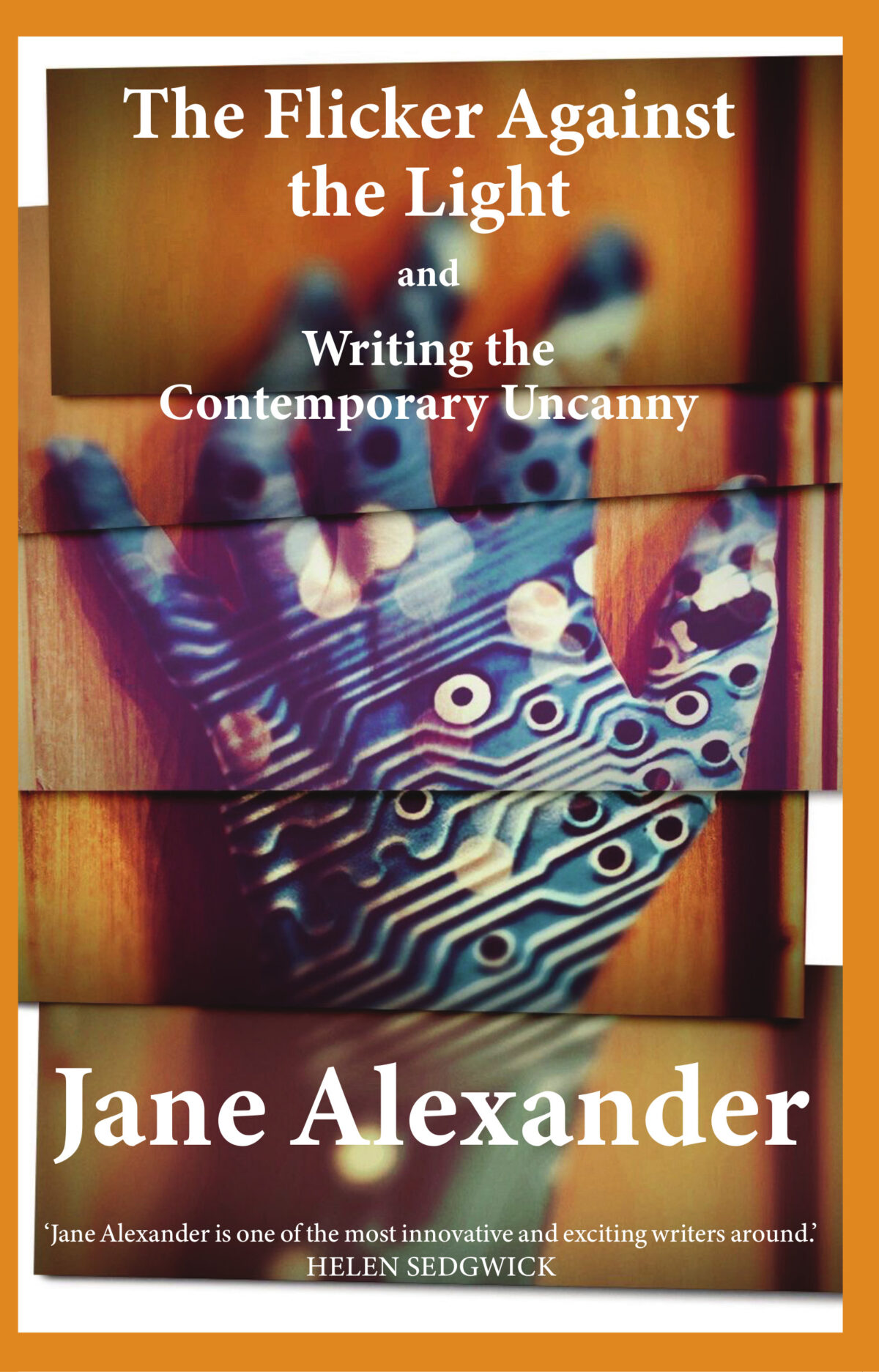
The Flicker Against the Light
Publisher: Luna Press Publishing
Publication date: 1 June 2021
ISBN: 9781913387594
Format: Paperback
Extent: 220 pages
A woman walks through a virtual reconstruction of the destroyed streets where she and her lover used to live. A young man trades away his youth, and something of himself, in the plasma extracted from his blood. A clone addresses her dead, doubled ‘self ’ as she tries to understand her personal history. In these uncanny stories of virtual reality, biotech, data surveillance and communications technology, Black Mirror meets M.R. James: unsettling perspectives on contemporary and near-future scenarios are layered with hauntings; borders are blurred between living and non-living, real and not-real.
Accompanying the collection is the essay ‘Writing the Contemporary Uncanny’, an investigation of how the uncanny has shifted in the hundred years since Freud attempted to define it, and how uncanny short fiction can interrogate and illuminate our experiences of science and technology to help us understand what it means to be human in an ever-accelerating technological landscape.
About the Author
Jane Alexander is a novelist and short story writer, and a lecturer in creative writing at the University of Edinburgh. Her most recent novel A User’s Guide To Make-Believe is a dystopian thriller about virtual realities, and her first novel The Last Treasure Hunt was selected as a Waterstones debut of the year in 2015. Her short fiction has won prizes and been widely published, and her creative writing PhD thesis explored contemporary uncanny short stories about science and technology.
Find her at janealexander.net and @DrJaneAlexander.
Short Story
You can read the story below or download it as a PDF.
The Lag
It’s his gait that catches her attention. The limp is slight, but distinct enough for her to recognise. Below the knee, she’d guess. The opposite leg from hers. But the rhythm is the same; a kind of hiccup in each step. She finds herself calculating the seconds missed. Tracking the lag.
He is wearing a short padded jacket with trousers of some light, outdoor fabric. Once you know to look, they show what’s underneath, which is why she prefers jeans – or on days like today when she has to look smart for work, a good thick cotton or a heavy wool blend.
It repeats: the sole of his hiking boot meeting the pavement in a flat, familiar shape. What she sees in the stranger, she feels in herself – her tempo fractionally slower than his, a mismatched counterpoint. And though it’s not her turning, when he forks off the main street, heading east, she follows.
The paving is greased with the smirr that’s hung in the air all day, forcing her to watch her step. Fleetingly she loses him as a dawdle of tourists drifts between them. Visitors are fewer in number now the summer’s over, the air grown sharp and chill, but as ever this lot have left their street-sense behind. She slows, allows them to steer around her. Finds her pace again.
Used to be, her feet were how she’d owned this city. Walking, and running; threading through its unexpected turns and jinks. Her mind would set the pace, her body obey. A lunchtime saunter across the Meadows, purposely slow. A late rush to work, making up minutes with a brisk march. A dash uphill, taking the stone steps of the city’s staircases two, three at a time. She presses her lips together. It still takes her concentration, this careful back-andforth – and always, there’s the hitch.
There are so many ways for time to vanish in this new life of hers. All the medical appointments, for a start. The extra minutes in the morning, getting ready to leave the house; in the evening, tending to rubbed and broken skin. But it’s the lag that frustrates her most. Something about the almost-invisibility of it. The perfect crime; the theft of a second with every step. Once she’d started to count them, to add up all those fractions and fragments, she began to understand: how much time she was losing. How, almost imperceptibly, her future was being chipped away.
***
Ahead, the man turns left into the narrow close that falls steeply to the Cowgate. She hesitates. She’d allowed plenty of time to park and walk the short distance to the client’s office, but this detour is making her late – and the downhill is more of a challenge than anything she’s tried so far. It will strain her muscles, dig in behind her knee where, despite the dressing and the layering up of socks, pain pools in a dark, constant bruise. She’s not sure why she’s following him; still she keeps going. Slow, careful, missing the security of a stick. Each downward step takes her further from where she’s meant to be. She is losing minutes she won’t be able to recoup.
Time, and practice. That’s what everyone says: the doctors, the physios, the prosthetists. The fellow amputees. They talk about the new normal, say it takes a good while to get used to the changes. And it’s true she’s more efficient now than she was in those first weeks and months. Can move around the house well enough, get a bit of exercise most days. The slumps are to be expected. Sundays, for example, are hard. Sunday had always meant running club, and now it means crutches. It means the leg laid prone at the side of her bed, or leaned against her unyielding armchair – the only seat she owns that doesn’t put up a fight when she pushes herself back upright. Sunday means a day of rest for her stump, for skin chafed raw from constant pressure; means an always inadequate chance to heal, before another week begins. The other day one of her old running pals sent her a clip of an amputee sprinter winning the hundred metres against a dozen able-bodied athletes. Miss you babes, said the message. When you coming back to kick our arses? When you buy me a fucking state of the art blade, she thought, and deleted the message without replying.
She used to dream, before, of being able to fly. Now her dreams are of running. She can’t imagine rejoining her companions on their city circuits.
She plants firmly with the heel of her prosthetic, angling sideways into the slope. She can manage this. She’s moving forward. Just not fast enough.
The man she’s following is less cautious. His lead increases as the pavement narrows to a single strip of skewed slabs then disappears into ancient setts, gappy and worn. Arms out for balance, ready for a fall, she keeps her eyes fixed on the tricky terrain – and when at last she reaches the bottom, turns the corner onto the Cowgate, her quarry is nowhere to be seen.
The disappointment sucks at her, a slow sinking, as she checks in both directions. To the north and the south, streets and closes rise abruptly. To hike back up the way she came – it feels impossible. Frustration twists through her, a blast of rage at her own stupidity. What was she thinking, to put herself through this pointless detour, to strand herself in this shadowy chasm? She tightens her jaw, starts to weigh her options, and as she turns a thickset young man shoulders past on the narrow pavement, forcing her off balance. The sudden shift as she catches herself sends a bright pain jagging through her. Breathe, breathe through it… Her exhalation is ragged, clotted with the threat of tears – from the pain, but not only the pain.
If she can’t retrace her steps, she will have to go the long way round. A walk on the flat, a few minutes further, to the junction that promises a smoother pavement, a gentler uphill. She braces: takes a step, and then another. As she walks she reaches for her phone; she is verging on unforgivably late, must call to make her excuses, but her throat feels swollen with self-pity and she doesn’t trust her voice. Instead, she pauses to email the client, and when she starts to walk again her eyes are fixed on the uneven paving – which is why she doesn’t notice the shop door swinging open till the man, her man, steps onto the pavement, straight into her path.
Their apologies collide. He takes a single step back, catching the door before it’s quite closed.
‘You going in?’ he says, and perhaps it’s something in his tone – some note of assumption – that prompts her to nod. With an awkward, circling dance she assumes his place on the threshold of the shop, while he takes hers on the pavement. ‘First time?’ he asks, and she nods once more. ‘Ah don’t worry, he’s good.’ The man cocks his head. ‘Eccentric,’ he allows. ‘But good.’
He turns, heads back the way they came, setting a brisk pace – and she’s caught by the difference. The ease of his gait, its steady rhythm. Narrows her eyes: she must have got it wrong, before. If anything, now, it seems to be the left leg that holds him back. She watches, still clutching the door, till he turns the corner, vanishes from sight. Then, aware of the heat billowing into the frosted November air, she steps inside and lets the door swing closed.
A fuggy warmth mists her glasses. The interior blurs to an impression: of clutter, and wallpaper fleshy pink with flowers. There’s a smell too, something homely and unexpected that she can’t identify. She waits for the fog to evaporate, for someone to greet her, but as her vision clears she sees the place is empty. The wooden counter to her left runs the length of the shop, unmanned. Behind, a green-tiled fireplace is topped by a peeling mantelpiece that supports an ornate gold carriage clock and several more modest timepieces. The shelves that line the walls are shabby and makeshift, piled with boxes and packets, with pliers and screwdrivers and unwashed mugs, with the glinting glass and metal of disassembled clocks.
Still unobserved, she turns to her right. On the far wall another set of shelves is filled with yet more clocks, dusty-faced mantels and carriages. A grandfather stands in the corner; a grandmother perches on the windowsill. In the very centre of the room is a chair like a throne, crazed red leather with open arms held up on dark wood twists.
In the window is a sign, cracked white melamine. The lettering forms a shadow-sign legible from the back:
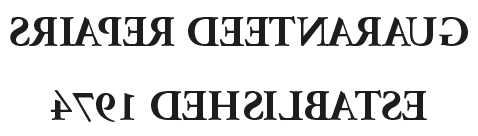
She turns back to the counter, leans over till she can see where it becomes a workbench littered with tools, papers, a drip-stained mug; further, into the depths of the shop where a man stands with his back to her.
‘Hello?’ she calls.
The man turns. He is elderly, balding; his expression is one of surprise. In his right hand he holds a spatula, in his left a cast-iron frying pan contains a single egg, frilled at the edges. ‘Oh dear,’ he says. ‘Did it ring, then? I never heard it.’
He means the entry chime. She can’t remember hearing it; tells him so. She can see now that there is a two-ring hob tucked into the corner. The man – the proprietor, he must be – sets down his frying pan.
‘Ah well,’ he says. ‘Sometimes it does and sometimes it doesn’t. I thought while the shop’s empty I might as well have my lunch, but it’ll wait. It’ll wait.’
‘Please, don’t mind me,’ she says, but already he’s wiping his hands on a tea-towel, taking up his post behind the counter.
‘Now. I hope I can do something for you,’ he says, ‘because so far it’s been a bogey of a morning. I keep sending folk away because I can’t help them. It’s Mondays; people bring things in that they’ve been meaning to bring all weekend, and sometimes the things they bring … well, there’s nothing I can do for them.’ As he speaks, he is fiddling with a bill-spike that sits on the counter, stroking the edges of scores of paper slips, and she sees that although he is a stout man his fingers are slender, and perfectly clean. He’s addressing her, but his manner suggests he’s talking to himself. She’s not sure if he expects her to reply.
‘But not the man who just left,’ she says.
For the first time, the shopkeeper looks at her properly. ‘Ah, no. I was able to help, there. Although, that was only an adjustment, a bit of fine tuning.’ He studies the length of her. ‘Your job may not be so straightforward. But we’ll see, we’ll see. Take a seat,’ he says, and gestures to the battered armchair.
The offer is seductive; the steep descent burns all the way up her good leg, throbs below her left knee. Hands on red leather arms, she feels with the backs of her legs for the level of the seat – and it’s only once she’s settled onto the sagging cushion that she becomes aware of the sound: a sea of ticking. It seems impossible that she hadn’t heard it straightaway, the conversation of scores of clocks crammed into a space the size of her living room. She’d been distracted by the strangeness of this place, or focused too hard on what the proprietor was saying to her, what she should say to him.
Now he flips up a section of counter, comes out to stand in front of her.
‘Now then,’ he says, ‘let’s get that off, and we can have a proper look.’
Automatically, she lifts the leg of her trousers, complying with a suggestion familiar from the mouths of countless medical professionals. But this is not like being at the doctor’s. Not routine, impersonal. It is as if she is undressing in front of him. She’s about to pull the trouser-leg back down, apologise for wasting his time, when he takes a step back. Turns to fossick about with the parts on his workbench, allowing her the privacy she needs.
Still she hesitates. He seems like a harmless old man – but what if he locks the door? What if he turns on her, is stronger, more determined than he looks? Her keys are in her backpack, on the floor by her foot; she would feel safer if she had them in her pocket, ready to make a sharp fist. Eccentric, but good, she reminds herself. That’s what the other man had said; the man who left this place with a loose, easy gait.
She presses the release pin, slides off the leg. When she offers it to him, she might be handing over her child.
Even before he takes it from her he is nodding. ‘Maybe,’ he says. ‘Yes well, we might be able to do something about that.’ Deftly, he unlaces her shoe, strips the sock from the foot and tucks it inside. As he hands the bundle back to her, his attention is already focused on the mechanism. He carries her leg behind the counter, lays it on his workbench. Screws a magnifying loupe into his right eye. ‘Losing time,’ he says. ‘Yes well, seen that often enough, that’s a common one. And the balance is twisted!’ He sounds indignant, as if the faults he can see are the result of sabotage by some enemy they have in common. ‘Yes, it’ll take me a while, this one.’
In the chair, she fidgets with her trouser-leg. ‘How long’s a while?’
‘Oh, hard to say, hard to say–’ He stops, opens his mouth and closes his eyes in a tremendous yawn, dislodging the loupe from his eye. He catches it neatly, screws it back in. ‘A matter of hours, it’ll be. You’re welcome to wait.’
To wait.
Since she has no other option, that’s what she does. She pulls off the socks that fill out her stump so it fits better in the socket, peels off the liner, and folds down the leg of her trouser to cover her unfoot. She submits to immobility; the chair is comfortable enough, and she’s made sleepy by the heat that turns to condensation against the cold of the shop window, blanking the world outside. Curled into her throne, good leg folded under her left, she allows herself to sink into the ticking that flows around her. To be soothed by its constant, rhythmic lull. She drowses, dimly aware of the coming and going of customers, the blast of cold air, the chime of the bell. They come to collect their mended clocks, to replace the batteries in their watches. Once, she watches the proprietor hand over a long, limb-shaped parcel wrapped in brown paper to a fat man who takes it with care, hugs it under one arm as he leaves. In a shop whose walls are lined with clock faces, she contrives to lose track of time. To fall asleep.
***
The leg, when he hands it over, is impatient, the foot squirming on its ankle. The calf and shin are warm, blue-veined and in need of a shave. With a slight embarrassment at the fine dark hair – he must think she’s let herself go, and perhaps she has – she slides it on, circles her palms around the join. Seamless. Her thumb rubs back and forth, feeling the fine-grained texture of her skin. She flexes, and the movement sparks along muscles and tendons – and she’s on her feet, and running. Along the canal, a steady sprint, sun sparking off the water; breath easy, blood flowing, her arms swinging loose… Across the Meadows, not a sweat on her, the quick light thud of her feet on the track – she is making good time, overtaking her friends with a brief backwards wave – she is running like flying, a personal best, faster than wind through the summer leaves–
‘Alright then,’ he says, and she opens her eyes. Outside the metal shutters are drawn halfway down to cover the window. She doesn’t recall the rumble of their closing, must have been properly asleep. Now she’s awake, pins and needles are dancing in her right leg, a stale pain throbbing in her left.
Mr. Guaranteed Repairs is talking her through the adjustments he’s made, details she’s too groggy to follow. Her mouth is dry, and she’s hungry – so hungry she feels it tremor through her hands as she holds them out to receive the familiar weight.
She had thought he might need to strip off the padding she’d added, peel away the glued-in strip of leather that cushions the back of the socket. But it looks just the same. She strokes the smooth, cool fibreglass, brushing away an accumulation of imaginary dust. It looks untouched.
When she bends to roll on the liner, her bladder complains – but she doesn’t want to ask if she can use the shop bathroom. All she wants, now, is to be at home. She tugs on the socks, slides into the prosthetic. Pushes up with her arms, and uses her weight to lock the pin into the socket.
‘Better now?’ he says.
She shifts her weight from one side to the other, feeling for any difference. Anticipates the sharpening pain a second before it blooms, and tries to hide her wince. From politeness, she agrees that it is indeed better.
‘How much it will be?’ she asks.
The sum he names might seem unreasonable, if he hadn’t been working all afternoon. She doesn’t carry that much cash, but from under the counter he reveals a card machine; she’s surprised that he should be equipped with such an up-to-date facility.
‘If you need any adjustments,’ he says. ‘Don’t be a stranger. Any fine-tuning, you know where to find me.’ As she ducks awkwardly under the metal shutters, he’s already turning off the lights. She hears the door lock with a solid click. Don’t be a stranger: but she has the feeling that if she were to walk this way tomorrow the shopfront would be blank, its contents vanished along with its proprietor.
***
A left turn leads to the junction and the smooth, gentle gradient that would take her, eventually, back to where she left the car. Instead – without conscious thought – she turns right. Starts to retrace the steps that brought her here. It makes sense, of course: to try the proprietor’s workmanship on the most precipitous slope, the roughest terrain.
Into the rise, she begins to climb. Her breath comes in clouds, shorter and faster as she gains altitude. The ground is slippery with frost; from habit, her hands are lifted from her sides, the better to steady herself as she navigates the uneven setts and slabs.
The balance is twisted, he had said. We might be able to do something about that.
It goes against all her instincts to test it. To insert her hands into her pockets, and keep walking.
One step, and another: her footing stays steady. Hands in her pockets poised for a quick draw, ready to catch herself. At the side of her knee-cap the socket pushes, a predictable, stabbing rhythm; by the top of the hill there will be a fresh bruise, violet layered on fading yellow. But the pain is accompanied by an unfamiliar sensation, one she can’t precisely locate. Diffuse, anticipatory: like the moment before the pleasure of a stretch.
The feeling tugs her, or she chases it, she’s not sure which; she climbs, her left side leading, and if anything now it’s the right leg that’s holding her back. When she looks up, risking a glance to see how far she has come, the top of the hill is close, much closer than she had imagined. Seconds lost, seconds gained. She finds herself calculating; counting, step by step.
It isn’t a jog. It’s not even a march. But she’s almost there, and moving more swiftly than she had thought possible. Something in her – something of her – running fast.
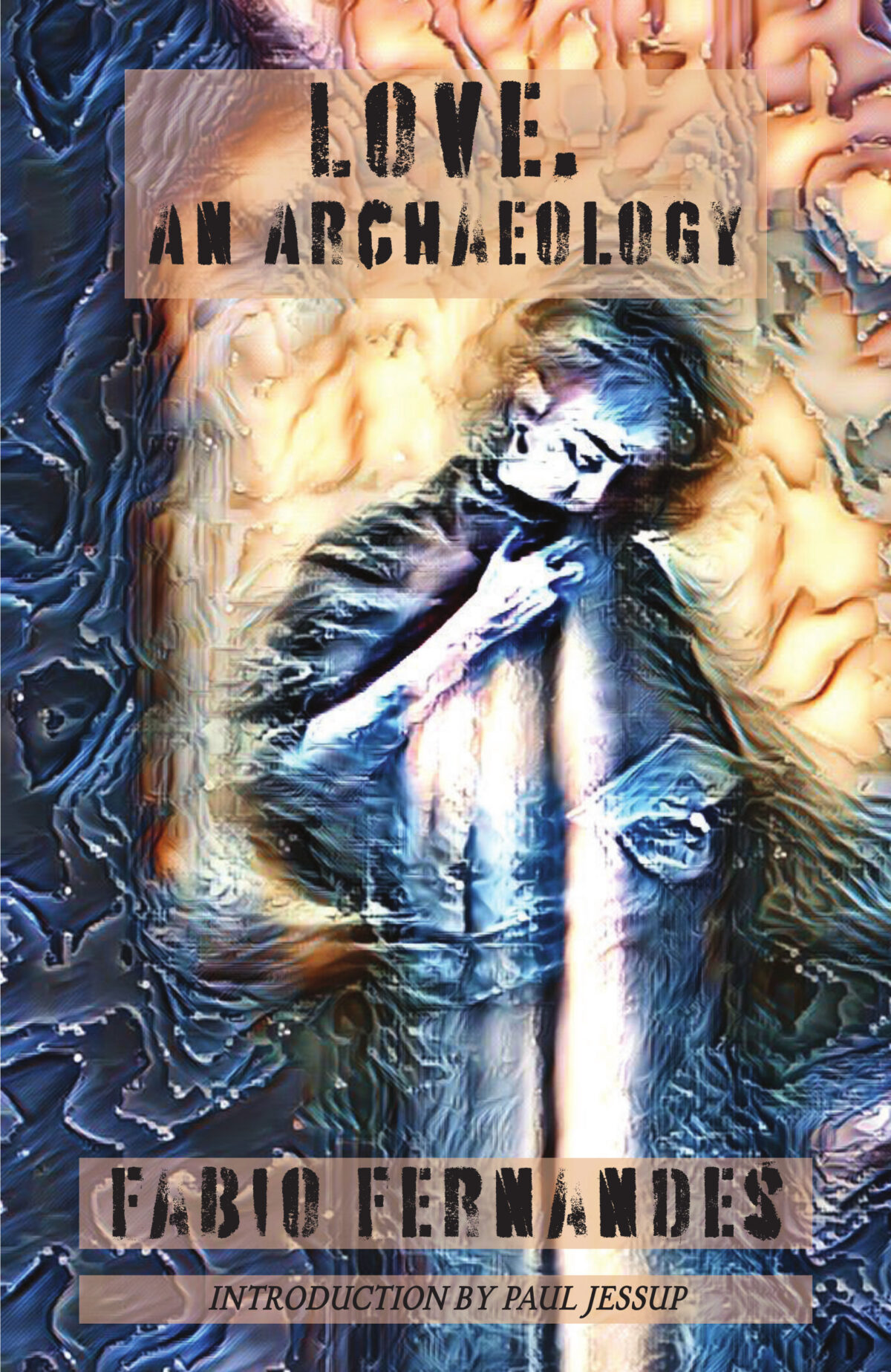
Love. An Archeology
Publisher: Luna Press Publishing
Publication date: 26 March 2021
ISBN: 9781913387419
Format: Paperback
Extent: 176 pages
Fourteen stories, ranging from science fiction to weird, mixing future scenarios (on and off-Earth) and alternate realities, but in fact, they are essentially about one thing: love and its malcontents.
A man who refuses to let death erase the memories of his loved ones; two time travellers leaping through the aeons in a literal love-and-death relationship; a murderer in love with the ghost of his prey – and more.
What would you do for love? What lengths, in space and time, would you go to? These characters have done it all.
About the Author
Fabio Fernandes lives in São Paulo, Brazil. He has published several books, among which the novels Os Dias da Peste and Back in the USSR (in Portuguese) and the collection L’Imitatore (in Italian). Also a translator, he is responsible for the translation to Brazilian Portuguese of several SF novels, including Neuromancer, Snow Crash, and A Clockwork Orange. His short stories have been published online in Brazil, Portugal, Romania, the UK, New Zealand, and USA, and also in Ann and Jeff VanderMeer’s Steampunk II: Steampunk Reloaded and Southern Fried Weirdness: Reconstruction (2011), The Apex Book of World SF, Vol 2, Stories for Chip. Co-edited (with Djibril al-Ayad) the postcon anthology We See a Different Frontier, and, with Francesco Verso, the anthology Solarpunk – Come ho imparato ad amare il futuro.
Graduate of Clarion West, class of 2013. Formerly slush reader for Hugo Award-winner Clarkesworld Magazine.
Short Story
You can read the story below or download it as a PDF.
Seven Horrors
Nobody knows why the Time Traveler decided to kill himself. It was even more confusing when the other members of the Fellowship found out that the Assassin was scouring the ages after him.
First, because to kill a suicide seemed like a very ineffective—and futile—thing to do. Second, because the Time Traveler and the Assassin were deeply, madly in love.
When they got wind of this, the Traveler’s friends (that is, all the members of his Fellowship, or pretty much all of them) thought he was going too far—literally—in his escape. That’s because they thought the Traveler was running away from something. Not true.
He had really wanted to die. Just not by the hand of the woman he loved.
***
The first confrontation between the Assassin and the Time Traveler happened in the Permian, 254 million years ago. Not long after the eruption of the Siberian megavolcano that put an end to millions of species you never knew anything about, nor will ever know.
But it was a tiresome, ludicrous, pathetic event: the Assassin materialized before a tired, depressed Traveler, facing him through a swirl of falling ashes and the heat of smouldering woods around them.
It was the beginning of the end—of one of the ends, actually. The history of those two time-crossed lovers was very far from ending.
Without trying to get closer to him, the Assassin vanished in the Time Corridors as quickly as she had gotten in there. That’s why that first contact, so to speak, could in all honesty be called an event. A meeting, a metaphor at the same timesimpler and more powerful than that famous song of the 20th Century: two ships that pass in the night. Or a warning: Brace yourself. I am coming for you. A loving warning, if such a thing can be said of a death sentence.
***
Until the early twenty-first century, five big extinction events were recorded on Earth, namely: the process of glaciation in the Ordovician, the meteor impacts in the Devonian, the Siberian megavolcano in the Permian, the greenhouse effect in the Triassic and the Yucatán impact in the Cretaceous. The sixth is beginning right now as you read me: it’s your Anthropocene. But it doesn’t matter, not now.
Every other one of those extinctions, as you can see, is much more catastrophic than anything else that had ever happened to humankind in its comparatively short, so short, journey upon the Earth.
The Fellowship has another name to call extinction events: Horrors. Definitions of what would exactly constitute a Horror don’t necessarily encompass size, but intensity. The history of humankind, for instance, is chock-full of never-ending horrors. That said, the Traveler’s list was strictly personal, and was based on his grieving.
His idea was to use each and every one of those in his very unusual suicide.
***
Let’s be brutally honest: anyone can kill him or herself very easily. The evolution of technology was very helpful to human beings in this sense. Naturally, not everyone needs such elaborate help. Really brave people just cut their wrists and wait for death to come by massive blood loss. It’s a slow, painful process (which can be expedited if you cut along the veins rather than transversally). They can also hang themselves. A shot in the head, if correctly administered, can kill instantly—but if it doesn’t, the would-be suicide might spend the rest of his probably long, hard life wishing he or she was very dead.
To throw oneself under a vehicle (preferably a bus, or, better yet, a high-speed train) should be enough. Also taking an overdose of pills, especially sleeping pills. Psychotropics may not have the desired effect, and they also can confuse the user in such a way that he or she can’t know the difference between being alive or dead (this might be good, actually).
But I digress. The important thing, regarding this narrative, is that the Traveler wanted to kill himself. And, despite all the evidence to the contrary, he really wished that. But it wasn’t that simple.
***
Time traveling has apparently only one side effect. To live forever.
This is not a figure of speech. This is not a philosophical wordplay with paradoxes or some such. According to the Inventor, the Cherenkov radiation emitted by time traveling affects directly the aging processes.
She doesn’t know why that happens. In millennia of temporal exploration, no one ever found out the reason.
What is known (and this is just because there’s one recorded case in the Fellowship, of the individual known as the Cadaver) is that immortals can die if they absorb an amount of Cherenkov radiation larger than the average in a very short time. For that to happen, though, one must travel almost nonstop through the Time Corridors.
***
The Time Corridors are exactly that: corridors. More about them in a while. Patience, please.
***
Something which the Traveler got used to during his stint at the Fellowship: traveling to uncomfortable places. Phobotopias, the Chronicler named those oh-so-likely places, of quite difficult description even for this member of the Fellowship, who had centuries (or more) to hone his skills. But some of those places are impossible to imagine because no one who hadn’t been there is even remotely aware that they exist.
Imagine the Seven Wonders of the World. Now imagine their opposite.
The Seven Horrors of the World is the name the Chronicler gave them.
The Chronicler is not the bad guy in this story, but it’s a damn big bastard.
***
What’s the Fellowship, after all? You must be curious to know what this group is that I’ve been talking so much about until now.
Very well: the Fellowship is a band of time travelers that attained immortality. How the Fellowship came to be, not even its members can remember for sure. The group is apparently as immortal as its members, maybe even something born with the Earth itself, or with Time. A few mortal writers had a brush with the concept. Hermann Hesse, for example. He tried to describe it in its forgotten classic Journey to the West. He wasn’t entirely successful, but for someone who never roamed the Time Corridors, he got the gist of it in a very interesting manner.
I can’t tell you more than this. Yes, I will be bold enough to use the time-honored cliché of the impossibility of understanding on the part of people from earlier ages, but I use that only because it’s true. You come from our past, or rather, from a remote, basic point of our hypercubic superstructure (I told you you wouldn’t understand). For now, suffice it to say that there existed-exists-will exist a group of people, a band that lived-live-will live apart from everything, from time and space themselves. And those persons would give everything to have what you who read me already take for granted: the hope of dying.
***
But not everyone has reached the point of the Cadaver, or even the moment just before the ebullition, as was the case of the Traveler.
Hm. I’ll have to interrupt my train of thought again to clarify one thing.
You must have noticed by now that every single member of the Fellowship has names that are actually indicative of functions. So far so good, right?
But, if all of them are time travelers, why does only one of them go by the particular title of Time Traveler?
The answer is simple: he is the first Time Traveler, the original one, the foundation of it all, the alpha and the omega. But he can’t remember any of it. Let’s follow him in his findings.
***
Speaking of which: we have no names, not anymore. It’s not necessary: each one of us recognizes him-herself by the structure of the DNA, by the all too particular curves and loops of the chromosomes, by the density of nucleoli and the rhythm of the bombing of the blood through veins and arteries. A name of this kind translated for any of the old languages of the Earth of the Sixth Extinction would have more than a mile of length it put on paper. Fortunately, this—written language—do not exist anymore. This time is long past.
Even for time travelers.
However, there is something inexplicable—and deeply annoying— in those post-humans who insist on making themselves known by certain titles. Would it be a kind of generosity, of compassion, loving kindness maybe? As humans used to say in the old days, I run out of fucks to give.
What I do know—and would be happy to share with you—is that the Traveler decided to kill himself doing something that nobody expected.
Acceleration towards the horror.
***
The Second Horror visited by the Traveler was the Yucatán Holocaust. The force field used by the immortals to prevent contamination from both sides would also allow him to breath in the Cretaceous atmosphere, still too filled with carbon dioxide.
He arrived two days after the impact—the ideal moment for someone who, like him, didn’t want to die on the spot (for we could have easily been spared all this story if he had just stayed exactly on the impact point when the asteroid struck—I forgot to tell you that, although knives or bullets can hardly make a scratch on their bodies, immortals can be killed bycataclysmic events that utterly destroy their bodies). But the Traveler was a romantic. He wanted to die slowly.
This, however, doesn’t mean he wasn’t smart. Real suicides always are. What he really wanted was to accumulate enough radiation to reduce his immunity instead of boosting it. (During one of the countless, sometimes heated, theoretical debates between bored immortals, the Inventor claimed that this strategy would probably work.)
The average temperature of what would be Mexico during the end of the Cretaceous was 73.4 degrees Fahrenheit. But not during the extinction event itself: the Traveler’s equipment registered 152.6 F on the lip of the crater.
His companion AI protested. In vain. The Traveler knew all too well the risks.
And that was exactly why he shut down the force field.
The winds of forty miles per hour almost took him down, but he stood his ground. His lungs, however, suffered the full impact. The Traveler doubled over, feeling a sudden dizziness. His throat and nostrils burned horribly. His lungs wereprobably collapsing, but all of this wasn’t enough to kill him.
He just stood there, surveying everything around him as far and wide as possible. The Traveler was a suicide all right, but he wasn’t a masochist. Not much, anyway.
Then the Assassin arrived.
They faced each other across one of the minor craters (a few pieces of the asteroid came off and struck the ground beforethe main impact). As if they weren’t breathing. That’s what was happening to the Traveler, at least. When his breathing started to fail, he turned the force field on again and left. He wished he had sighed, but his lungs were burnt enough to make that an impossible task.
***
In the beginning, the immortals always traveled together, like a band of brothers—or of wild animals. There were legion, but this legion quickly divided in subgroups that met once in a blue moon, until they finally decided to meet once a year.
They never met on the same place twice. Paradoxes. Better to avoid them.
The meeting that time was at the Never-ending Party.
New York, turn of the millennium. The third, by the Christian calendar. 2000 to 2001. In the last floor of the World Trade Center, naturally.
The Traveler entered the room with a cold sweat. He hated crowds, and despised parties even more, but on the other hand he appreciated a good imbibing, so whenever possible he tried to annul one hateful thing with a much adored one.
He had just poured himself a drink (a gin and tonic, bitter and dry the way he liked it) and then found the only person he really didn’t imagine seeing anymore in the group’s alcohol-fueled meetings.
No, it wasn’t the Assassin. She will reappear many times in this narrative.
It was the Enlightened.
The Traveler was fundamentally a non-believer. Right at the inception of the Fellowship, they had decided to avoid anykind of visit to the origins of the world’s religions—any religion, from the main ones to the first ones, or even the long forgotten creeds or the very last ones at the End of Days. But it was impossible not to be impressed with the Enlightened. Sheseemed to emit a strange aura, something hard to explain, something that blurred the curves of her body. (He had alreadymentioned this to the Inventor, who told him he had the same feeling. However, he hadn’t detected any kind of radiation or device able to produce such an effect.)
She was standing in a corner, holding a bottle of sparkling water. Since she became an arahant, that is, the very last stagebefore attaining full Buddhahood, the Enlightened didn’t drink alcohol anymore. In fact, she barely ate. She depended on the pindapata, that is, food donation from the practitioners or anyone who cared. If nobody offered her food, she would spend the entire day without eating. That had happened many times, and she never complained, not that he knew of. This pissed him off deeply.
Besides, she seemed to behave pretty much as a nun, but didn’t dress as one. The Traveler never understood completely his ex-wife.
“Hi,” she said when she saw him, beaming.
“How’s it going? Are you okay?” he asked her, but he knew it was in vain. She just stood there, smiling, not saying a word. A Buddha is indifferent to notions such as good and bad.
“Have you met Jan?” She gestured towards a young man who was at her right side, and of whose presence the Traveler hadn’t been aware until that very moment. “He is an Oneironaut, a dream traveler. He’s visiting us in his dream.”
Once upon a time, the Traveler would most probably have cracked a not very funny joke, using wit to exchange ideas and information with people like the Oneironauts. Not anymore. And that was precisely a symptom of his illness.
“How do you do? Are you enjoying the dream?” he just said, nodding in his direction.
“It feels good to be here,” Jan said. They exchanged a few pleasantries, but nothing remarkable. The Oneironauts belong to other narratives. This is the one that interests us, and it starts again in the second that Jan, the Oneironaut, vanishes before their eyes.
“The Sleeper awakes,” the Traveler said.
“Where are the others?” asked the Enlightened, ignoring the belated witty pun.
“Aren’t they here yet?”
She shook her head. The Traveler only shrugged his shoulders and sipped his gin. The irony of time travelers being late never gets old.
One must understand that an arahant, or Buddha, or enlightened person (as far as this narrative is concerned, all these denominations are the same thing) has the perfect knowledge. There are no analogies able to totally explain this concept, but an image that may be of some help is the auditory phenomenon known as perfect pitch. This skill allows a musician to identify and name all the tones of a given chord. Perfect knowledge is simply to know everything that’s going to happen—not because of supposed determinism (that doesn’t exist, according to the Enlightened: the fact is that too many actions exist that repeat themselves in the timeline, for everything that’s infinite tends to repeat eternally, and it’s precisely that repetition that gives the Samsara its shape of a wheel. Hm.), but because time is not linear. Never was. The Traveler knew that already; he had had many conversations with her since she achieved illumination.
“She’s not coming?” he finally deigned to ask.
“One does not need to attain nibbana to know that,” she answered compassionately.
“I attach myself too easily,” he said, not unironically.
“Every kind of attachment is delusion,” the Enlightened said. “I always imagined that our group would understand thatbetter than the anchored humans.”
“We are not anchored to the arrow of time, but we are still pretty human,” he retorted. “Except you.”
She laughed.
“I too have a human body,” she said. “But this is not me.”
The Traveler never showed any interest in Buddhist philosophy. Everything seemed so complicated to him. But sometimes he felt a pang of sadness and mourned his own lack of interest on the subject. “I guess that’s my cue, then.”
“I’ll organize a retreat in Bangkok next year,” she said. “I’d like to propose that our group meet there next time.”
“It would be interesting, But I’m not sure if I’ll be able to attend.”
“I know. Be seeing you.”
***
In the original time of the Traveler, humankind—that is, those who survived all the wars and decided to stay on Earth after the Post- Human Transition—learned like in no other moment in the long, not-very-well-recorded human history, the idea of dedication. It was, surely, an almost obsessive dedication that led the people of that age to have deeply focused interest in one subject, one object, one skill, one love. Nothing was done half-heartedly. A person who lived at the time of the Third Mentality (120th Century by the Christian calendar, which had been replaced by the Stapledon Pattern) was either a perfect artist, a perfect engineer, or a perfect athlete.
Or a perfect assassin.
Everybody did what they wanted to do and were encouraged to pursue their way. No subject, no ability, nothing was taboo. If everything was transitory, everything was permitted. So they forged on.
The Assassin was maybe the most dedicated member of the group in what she did.
***
The Third Horror happened in the Twenty-Third Century C.E. I am telling you this for your exclusive benefit. The immortals didn’t guide themselves by the notion of linear chronological progression, for everything was time to them. Labels served only as signposts on the Corridors.
But it might interest you to know that the Apophis Holocaust happened in 2266.
Since humankind started to sweep the sky in search of asteroids on a collision course with Earth, such an event wasexpected. The visitation of Apophis was being announced since the early 21st.
It was huge. Bigger than the Yucatán meteor. Much bigger.
Nobody knows for sure how people survived after the impact. The orbital elevator that was being built over the equator was destroyed, and the few areas that weren’t affected by the shock waves of the cable fall suffered with the nuclear winter that hid the sun from view for more than a year. Less than five per cent of humanity survived.
When the Traveler arrived there, many people were still alive. Most of them were agonizing, because of wounds, hunger, disease, or all three combined. He walked through the recently formed Southeast Asian Basin, where only a few daysbefore stood the Bay of Bengal and the Andaman Sea, both vaporized and now filled to the brim with debris of what used to be Myanmar, Laos, Thailand, Malaysia, and Cambodia. His feet, wrapped in paper-thin sandals (an affectation that always pissed me off no end, because it hurt his feet unnecessarily), could feel the rubble formed by rocks and bone shards. The air was hot, almost unbreathable.
“You really like your asteroids,” the Assassin said when she materialized by his side.
“Not only that,” was his answer. “How many jumps left?”
“You know the number.”
“I want to hear it from you.”
But, before the Traveler could say something, she sprayed something in his direction. The strain of Ebola Zaire that she had collected in the zero point of the first occurrence of the virus in the Yambuku village in 1976 was laced with a special inner time accelerator. It was a weapon that was quite hard to obtain even for members of the Fellowship.
The Traveler sniffed in the air the possibilities of the unfolding of events way before the viral cloud got near his body. He entered the Corridors without having time to bathe in the Cherenkov radiation of the Apophis aftershocks. He ran away feeling angry and sad.
***
The Fourth Horror was easy. The Traveler noticed that extinction events were just like that, probably because there were no humans around. He managed to map with impressive accuracy a point where he would absorb a huge amount of radiation in a very short time, and the Assassin somehow couldn’t arrive in time to face him. So, let’s skip the Devonian.
***
The Fifth Horror took place during the Armenian genocide.
It was a pretty hard time. Only those who lived through that could have the palest idea of what happened: during centuries this ethnic cleansing had been denied by the Turkish government and swept under the carpet for as long as possible. But you couldn’t hide anything from the Fellowship.
Not that they could do anything about it. History might not be deterministic, but the Fellowship had signed a pact of non-interference on the time flux. This pact wasn’t always respected, but most of its members thought the world was too complicated already, and they had a certain idea of their limitations. They would have to pull lots of superstrings to change the smallest stitch in the fabric of reality.
The Traveler left the Corridor and fell straight into a deep well full to the brim with corpses. All around him, one person or another, still alive, moaned in pain and asked to die. The soldiers at the lip of the crater did their best to comply, gunning everything in sight. The shots, naturally, didn’t strike the Traveler; one of the things that make the members of the Fellowship angry and nervous is that, once outside the conventional spacetime flow, nothing coming from them is able to affect them directly. The bullets are just possibilities for the Traveler, and the continuum works always and forevermore in his favor.
But he wanted to suffer. He craved for pain.
He crawled slowly until he finally got out of the well. It took him two days.
The Assassin was there that entire time. But she didn’t interfere. I don’t know exactly why, but my guess is that shewanted him to suffer as well. Death could wait a little longer.
***
What can be said about all this hullaballoo? There wasn’t a fucking epic thing on it. The members of the Fellowship were immortal, that’s a given, but deep down they were only human, and the entire history of the human race consists, has always consisted, of a more or less random succession of events, having death as the final destination. The sole thing that separated them from the rest of the humanity was the end. The middle, with all its ups and downs, its glories and pains, its joys and disillusionments, would be the same. I know this all too well. After some many years following the Traveler as his designated Artificial Intelligence, I should know.
***
Let’s talk a little about the Assassin.
Much has been said about those two characters, in quite a number of narratives both Western and Eastern, and in a number of universes. The two were living archetypes.
But their love story wasn’t meant to be happy.
Even though the names of each actor in this drama are archetypical, the Assassin didn’t start her… career, so to speak, by killing anyone. She didn’t even like to kill time while waiting for the classes at the university where, so many moons ago, she met the Traveler for the first time. And fell hopelessly in love with him.
It wasn’t exactly love at first sight. That took a while.
We also must define properly what is understood as time, since both met in the past in order to better study humankind, buteach one came from a different age.
The Assassin came from the far future. So far away that the notion of Mentalities, belonging to the Traveler’s age, was already archaic to her. Humanity had already set sail to the stars and started to explore alternate Earths—and understood that what we had always figured to be alternate Earths were in fact another thing, folds in the fabric of spacetime that allowed humans to explore potentialities unimagined until then. Time travel was just one of them, but until he met the Assassin, the Traveler only knew the Fellowship’s version.
The Fellowship’s version was this: time travel had been discovered in their own age. But versions varied: after all, not every member of the Fellowship had originated from the same time.
***
“I hate you. I hate you with all my heart,” the Assassin told him as soon as he arrived at the scene of the Sixth Horror.
London in the Great Fire of 1666 was a vision of hell. At least the Christian hell as seen in those times, and also for the next few centuries. This time the Traveler had his force field turned on, but attenuated so he could feel the heat and take a deep, not at all healthy breath of the toxic fumes.
The Assassin didn’t use a force field. But she walked through the fire without feeling anything.
The Traveler didn’t say a thing. He felt like crying, but the tears were vaporized as soon as they left the tear ducts.
All he could do was to deactivate his field.
A fraction of a second before the flames engulfed him entirely, he felt the full force of the impact. The Assassin hurled him through the Corridor.
Corridor, Schcorridor. Some call this system the Time Tunnel. Others simply Wormhole. The word of choice to the Fellowship members is just Corridor. Because the perception of who travel across the ages using that place (some call it adevice, but in fact it’s a place) is that of traversing a very long, cold, dark corridor. An utterly terrifying corridor.
He didn’t fall too far. He stumbled upon a green hillock somewhere in the Iron Age, under a cold drizzle that cooled his body in a very welcoming way. The crisp, unpolluted air helped to cleanse his lungs of the future smoke.
He could only think of one thing: if she hates me that much, why is she trying to keep me from taking my own life?
***
“Anger moves you,” the Enlightened told him the last time they met. Her retreat took place among the ruins of Bangkok after the Second Pan-Asian Confederation War in 3019—long after nuclear weapons had been retired and replaced with sonic and viral arsenals, which, combined, could obliterate in a very efficient way populations and landscapes in order to facilitate cleaning and reconstruction by the winners. The Enlightened and other arahants not belonging to the Fellowship (though they could have easily joined if they wanted, for Buddhas saw the scaffolding of spacetime continuum as it really was; that is, an illusion) had chosen that moment in time, between the utter devastation of the old Thailand capital and the building of New Bangkok.
“Anger is good fuel,” he replied.
“Does it work?” she asked.
He wobbled his head in the Indian way. To be near the Enlightened provoked in him the desire to behave like your stereotypical Asian, something he hated because he couldn’t see himself as belonging to any place now, but sometimes craved for anyway.
“I don’t know yet.”
“Will you keep on trying until you find out?”
“I suppose so.”
***
This story could only end where everything begins.
The Last Horror, according the Traveler’s calculations, wouldn’t be so hard.
Witnessing the end of Pangea demanded a certain refinement, as well as a great deal of patience on the Traveler’s part. He needed to undertake a true pilgrimage by the Corridor, almost a temporal Camino de Santiago, stopping along the way, making measurements with his Time Rose. The tattoo on his right arm shimmered with a myriad of colors, whose tone and intensity could tell him the exact point in time he was in with far more precision than human calendars or even the previous Terran races.
The Traveler could have speeded up the process, but he was a romantic; I already told you this. For him, the way was theanticipation of suffering.
He took six subjective days to arrive. Six days of meditating, moderate fasting, and total concentration on the goal ahead. To the Paleozoic.
He arrived at the early Cenozoic five minutes before the Indic Shock: the moment when the island which in your time iscalled India crashes into the Asian continent and forms the Himalayas by the sheer pressure of its tectonic plates.
The Traveler wasn’t the first to witness that moment, but there weren’t too many people interested in going there. The tremors ran the entire Richter scale (also the scale that would be created after Apophis). The Traveler calculated that the Ultimate Separation tremor could reach the equivalent of Richter 14 or 15—which would affect him very little if he left the force field on.
Naturally, he deactivated the field as soon as he arrived.
According to his calculations, the tremendous forces liberated by the Earth in the great pulses of the Indic Shock should release enough energy to give him an overdose of Cherenkov radiation—and finally kill him.
This time, though, the Assassin was waiting for him. “Why?” It was all he could manage to answer.
She didn’t answer. Instead, she charged at him at full speed.
The Traveler didn’t wait. He did exactly as I suggested to him while we were crossing the ages.
He returned to the Corridor.
***
The truth is, nobody invented time travel. The corridor—or the corridors, because the structure is manifold and all-encompassing, branching like a tree of infinite size—was/is/will be found, by people who were in the right place at the right time. Or in the wrong place at the wrong time. The eye of the beholder and all that.
***
The Traveler, naturally, was in the wrong place at the wrong time. He couldn’t enter the Corridor again. Instead, what happened to him was this: he was paralyzed in a kind of temporal sandwich, between one femtosecond and the next, unable to move. As in all great stories (be it of love or hate), the Assassin, being his nemesis, had a speech to make before killing him.
***
Another piece of information about the Assassin you need to know: she didn’t have this title originally. She was once known as the Physician.
She devoted her life to curing people. The members of the Fellowship especially.
It was because of his suicide attempt that she became the Assassin. Because she knew it would go south. And he would need help.
***
This time, however, the Assassin wasn’t alone.
At her side was a frightened, wide-eyed child. Maybe, actually, more intrigued than frightened, even though he didn’t understand anything at that point, and his heart rate was very accelerated for a seven-year-old child. The Assassin needed,her heart full of pain, to rescue her son from the abyss of time as evidence.
The force field used by the members of the Fellowship is an abstraction; there is no way to create a real quantum repulsion field capable of forbidding anything to penetrate and at the same time allowing air to get in and out the membrane. The solution found by the Inventor was simpler, if costly: to envelop the travelers in successive layers of spacetime. As asandwich. Provided that it was prepared at the same time in several different ages and eaten all simultaneously. The Traveler was the filling.
But, before she could say anything, he retaliated.
Between each Horror, the Traveler had time to plan a proper defense to the Assassin’s attacks. You don’t spend an eternity traveling through time without learning an entire Encyclopedia Galactica of ways to kill. Case in point being: all he needed to do was to project an identical force field in her direction. And invert it. The enveloping method can be used to protect—or to destroy. All you have to do is invert the layers.
When the Traveler sliced the spacetime in front of him, the Assassin wasn’t there anymore. She felt the impending dangerand jumped a few seconds ahead.
Leaving their son in the line of fire.
***
(Maybe you are wondering why she didn’t take the kid with her, or, in case that wasn’t really possible, why she didn’t rescue him from that horrible death. The answer is that she couldn’t. Because it had already happened. She was acting in accordance with a previous script.)
Breathing deeply, the Assassin got closer to the field that still surrounded the Traveler and finally said what she had to say.
***
“Listen,” she finally said. “The reason why I must kill you is that your suicide attempts are only making everything worse. The excess radiation won’t end your life. On the contrary: you will become immortal. And omniscient. And omnipresent, through all ages. You will feel an indescribable pain. I am doing it because I hold you dearly in my heart. And because we had a child together.”
“I didn’t know that,” he said.
“You never looked behind. If you insist on following your plan, you will never be able to not look behind, forward, now. You will not stand it.”
“And how do you know that?”
“Because it already happened. You are my past. The creature you will become is my present.”
“Why did you sacrifice our son?” he managed to ask after a long time, without taking his eyes off the twisted mass offlesh, blood and guts lying in front of him, and that suddenly started to shake uncontrollably, as did the entire plate they stood upon. The cataclysm had just begun.
“I thought you wouldn’t ask. But, in all honesty, I expected it to start later.”
Then the field collapsed. And the Chronicler acted.
See, in fact the Chronicler is not human. He was once, but that was long ago; the Chronicler is actually their son. The sacrifice was from the body only—his mind was stored in a crystalline data seed, which bloomed and gave fruits.
And it became a tree. Of infinite boughs.
The boughs of that tree make traveling through spacetime possible. The tree is more powerful than the tunnel. Maybe the tunnel is one of the boughs. I can’t tell.
You already guessed that I am the Chronicler, right?
***
“I had no children,” he said. “I haven’t transmitted the legacy of our misery to any creature.” He liked to tell to anyone who cared to listen (when he drank a bit more than usual) that he was the one who told Machado de Assis the last sentence of his novel Posthumous Memoirs of Bras Cubas, but that wasn’t true. Travelers didn’t change history, not even to create alternate timelines.
There are precedents, though. We’ll come back to this later.
***
What happens now?
We already established that time is not only linear, but also multidirectional and rhizomatic; that traditional rules do not apply when time is considered and, when they apply to time, they don’t apply to the members of the Fellowship.
We also learned that nobody dies from Cherenkov radiation overdose. We also learned that the process is much more complex, and the excess bring its user to a situation, say, untenable:
The physical body seems to multiply, like a row of clones, first forward and backwards, then to the sides, also up and down, and after that the superpositions become impossible for the naked eye to watch. To a theoretical external observer, it’s possible to see an expanding aura, like a water bubble mixed with a drop of oil, forming thus a super thin layer that shimmers in all the color spectrum, from the infrared to ultraviolet and other frequencies that don’t exist in the visible swath of the spectrum in quite a few universes.
A sort of echo in the spacetime continuum fabric that seems the sedimentation of a new memory, a memory that had ever been there already, as if the new was old, or not exactly that, but one of the foundations of the fabric of memory.
The feeling that every single dejà vu in existence, past, present and future, was created right in that moment, overlaying layers, echoing images, sounds, thoughts.
Other feelings, this one truly terrifying: realizing that, if there is a God, this was the moment of Its creation.
And the Traveler is God.
***
“I failed,” the Assassin will tell the Enlightened later, at the Thailand retreat.
“There is no such thing as failure,” the other will say. The Assassin will take a deep breath and say:
“This is not how it works. Things don’t stop being what they are just because you face them with indifference and self-help dictums.”
And the answer is going to be:
“You know all of this was written already. The Writer will take care of the rest.”
“If time is immutable, why didn’t you stop me? Why didn’t you stop all this useless fight? The sacrifice?”
“I didn’t say time is immutable. Everything changes.”
“Even the origin of all?”
“Even the origin.”
***
You are wondering why you are reading this narrative. It’s simple: you are being summoned to join us in the Time Corridors.
You are not special. Remember that immortality isn’t necessarily a blessing.
And we can always use more travelers. We are the ones who maintain a modicum of stability in this universe. The Corridors are the veins and arteries; we are the blood. Time is a virus that infects the universe. But is good that it exists; without the passage of Time, everything crystallizes.
Actually, the reason for your summoning is that my mother has failed. And my father turned into a god.
We need to kill him. I’m counting on you.