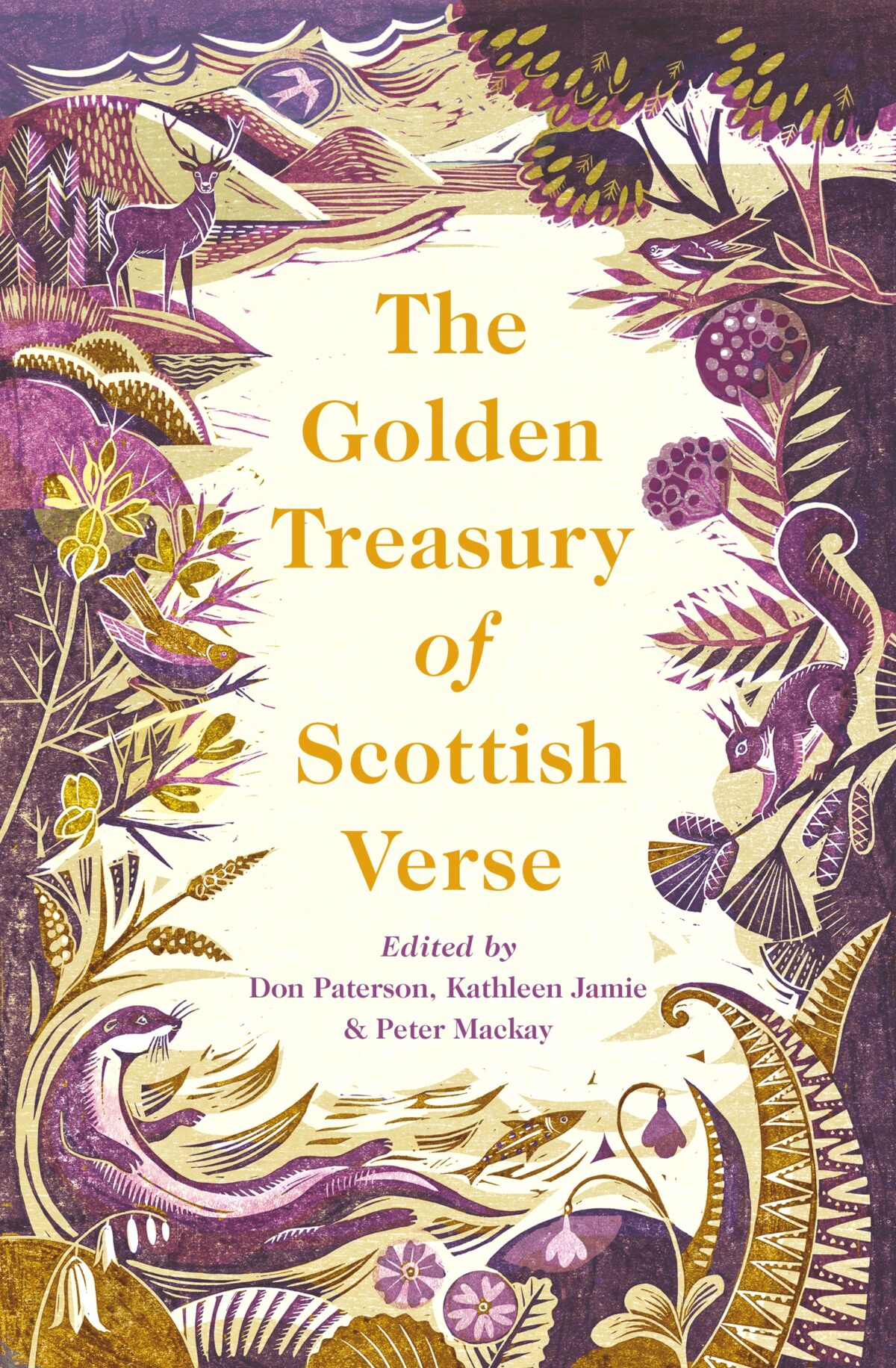
Advent Calendar, Day 21: The Golden Treasury of Scottish Verse
December 21, 2021On day 21 of #SantaBooksInt, editors Kathleen Jamie, Don Paterson and Peter Mackay introduce The Golden Treasury of Scottish Verse – a timeless gift edition of the greatest poetic works from Scotland’s literary past, present and future.
The Golden Treasury of Scottish Verse
Publisher: Canongate Books
Publication date: 16 September 2021
ISBN: 9781838852610
Format: Hardback
Extent: 544 pages
The Golden Treasury of Scottish Verse is a timeless collection of Scottish poetry. It contains over three hundred poems ranging from the early medieval period to the twenty-first century, and paints a full-colour portrait of Scotland’s poetic heritage and culture.
Edited and introduced by award-winning poets Kathleen Jamie, Don Paterson and Peter Mackay, and including poems by Robert Burns, Carol Ann Duffy, Sorley MacLean, Violet Jacob, William Dunbar, Meg Bateman, George Mackay Brown, Màiri Mhòr nan Òran, Robert Louis Stevenson, Jackie Kay, Liz Lochhead and many more, The Golden Treasury of Scottish Verse is a joyous celebration of Scotland’s literary past, present and future.
About the Editors
Kathleen Jamie is an internationally regarded poet and essayist. Her poetry collections include The Tree House, The Overhaul and The Bonniest Companie, which won the Saltire Scottish Book of the Year Award. In 2021 she was appointed as Scotland’s new Makar.
Don Paterson is a poet and musician; he is Professor of Poetry at the University of St Andrews and since 1997 has been poetry editor at Picador. His poetry has received many awards.
Peter Mackay is a poet, journalist and broadcaster, and lectures in Literature at the University of St Andrews. His collection Gu Leòr/Galore was shortlisted for the Saltire Scottish Poetry Book of the Year Award.
Introduction
You can read the introduction below or download it as a PDF.
The Treasury holds work in all our language traditions: Scots, early and modern; English, Gaelic, and a sprinkling of Latin, presented in translation. The English translations appear directly after the original poems. All are present in the room, all are whispering into each other’s ears, ‘Scotland, small?’ Despite the challenges they have faced, Scots and Gaelic are still living languages. Scots, especially, has proven itself receptive to the influences of the new communities Scotland has welcomed over the centuries. Our plurality of languages and dialects is a birthright, one which we should embrace wholly, and protect from class, political and religious affiliation. It is especially in our poetry that this diversity continues to flourish.
Speaking of class: the idea that poetry is largely an upper-class, courtly or ‘educated’ pursuit has never really taken root in Scotland. Certainly, these pages carry works by the nobility and aristocracy – though even these poems bear the Scottish trait of the ‘common concern’, and fret about the human business of love, birth and death. But always, always, we have the folk. The folk are aye singing, and weaving their loves and laments and best tales into the form they can best remember. Poetry and song are sister arts, and at times they have become culturally indistinguishable (we are arguably entering such a time again); in Scotland we have, of course, the great ballad tradition that Hamish Henderson declared our cultural gift to the world, and it is well represented here. The ballads were a people’s poetry, shaped and streamlined in the wind tunnel of their repeated telling. Of the people, too, was the work of Burns: his rallying cries to equality were a global sensation, his songs are still sung today, and the full extent of his work on the traditional songbook still unknown. Poetry here has never been de haut en bas – and our mixed, mongrel, diglossic language traditions saw to that. An earthly and earthy Scots was ever present. The Enlightenment was the product of the Edinburgh tenement, and the conversations it enabled between social classes helped to align Enlightenment ideas with social reality; the street has subtly informed our poetic speech ever since. (Arguably this may limit us too, and our tendency to ‘not get above ourselves’ has been a self-censoring influence on our poetry. In our natural suspicion of high-flown rhetoric, poetry after the Makars generally kept its heid doon: we had no Metaphysicals, and barely any Romantics.)
As we read through the centuries, we were struck by the sudden shrivelling of Lowland poetry post-Reformation. It practically disappears. After Knox, after the loss of the royal court, not only the theatres fell dark: the ability to turn a decent line of verse seems also to have been lost or forgotten, for all we will have kept singing under our breath. The literature recovered, but the long silence alarms. The Victorian era produced some strange eccentricities – Scotland churned out its fair, wretched share of rill and hills, brooks and nooks (invariably babbling and shady) – as well as an impressive line in Music Hall daftness. Then, of course, there’s the Kailyard, that cultural cringe wrapped in a couthy tale presented in a shortie tin. All this was ably expunged by Hugh MacDiarmid, whose political enthusiasms and personal flaws should never detract from the great corrective he was. But the nineteenth century also saw the emergence of a proletarian voice – of miners, mill-girls and weavers. The voices of women strengthen, becoming properly audible and de-anonymised in the twentieth century.
We have deliberately chosen to slightly over-represent more recent poetry – both to make the book engaging to a contemporary reader, but also to offer a sense of the stream of tradition becoming a delta, on whose banks we stand.
– Editors Kathleen Jamie, Don Paterson & Peter Mackay