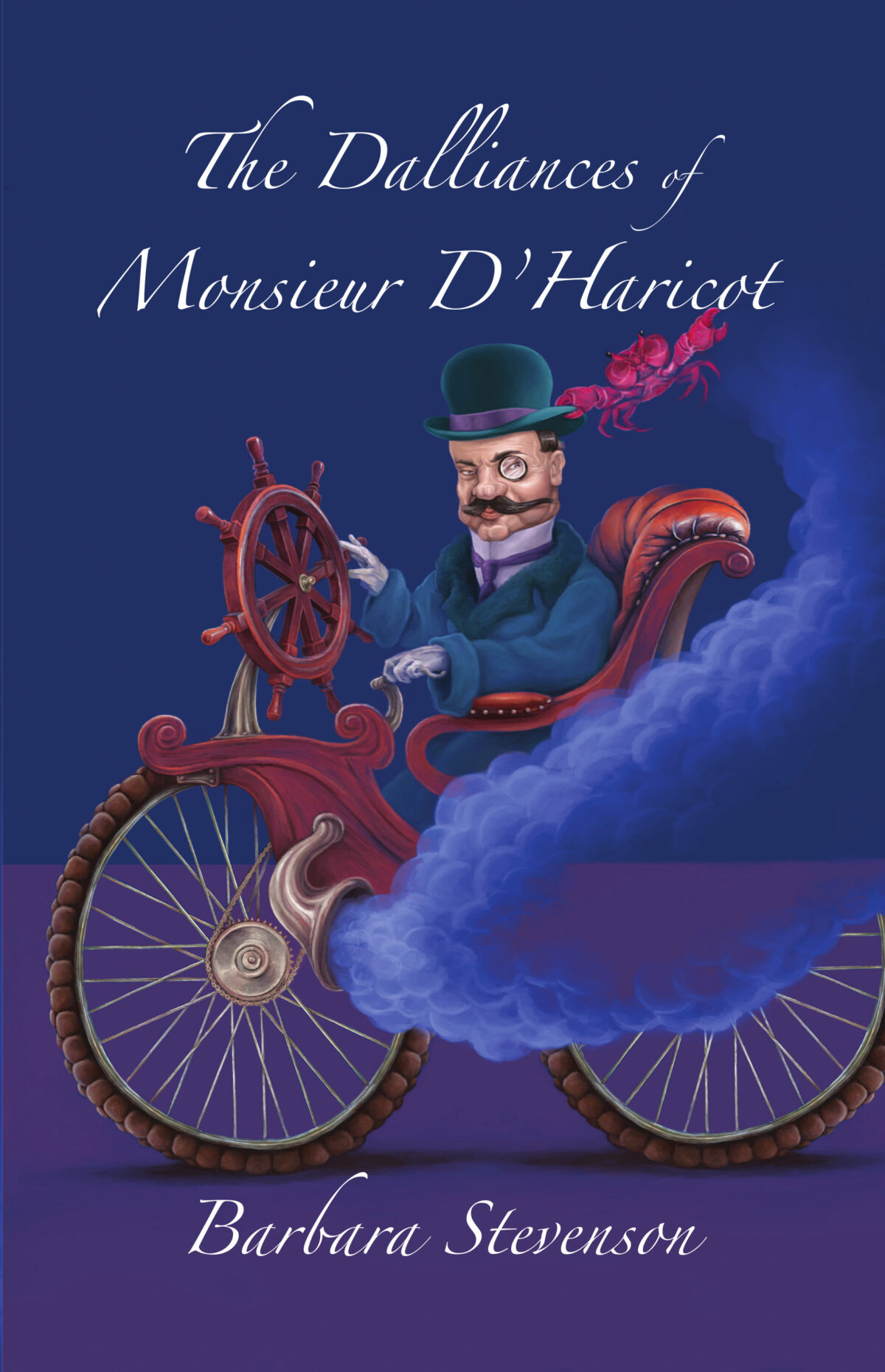
Advent Calendar, Day 24: The Dalliances of Monsieur D’Haricot by Barbara Stevenson
December 24, 2021On day 24 of #SantaBooksInt, we’re bringing you two chapters from The Dalliances of Monsieur D’Haricot – Barbara Stevenson’s latest fantasy novel published by Luna Press.
The Dalliances of Monsieur D’Haricot
Publisher: Luna Press Publishing
Publication date: 8 June 2021
ISBN: 9781913387396
Format: Paperback
Extent: 218 pages
Paris, 1930. Monsieur D’Haricot is a secret agent with a twitchy moustache.
Out of sight and mind, a community of refugees has been forced beneath the catacombs by centuries of persecution. They have built their own city, a replica of Paris, and developed advanced technologies and transport systems. With post-WWI Europe in turmoil, now is the time for them to resurface.
Monsieur D’Haricot has no problem with this, but a planned invasion is a different story altogether. He is, after all, duty-bound to protect France.
Faced with mistaken identities, split personalities, trickery, lies, downright lies, and repugnant bicycles, he will need to engage his complete repertoire of guile and espionage training to prevail. If that fails, well, at least he can rely on a little help from his friends: a sweet-toothed crab and an angel puppeteer.
The time is right for revolution, but the clock is not.
About the Author
Barbara Stevenson has a background in veterinary medicine and subsequently, animals feature in many of her stories – some with outspoken things to say about humans. She studied creative writing as part of an Open University BA (Hons) degree and has had a novel and short stories published. In 2014 her humorous sketch ‘Commonwealth Conundrum’, about Martians trying to join the Commonwealth, was performed in the Tron Theatre, Glasgow. In 2016 she won the Scottish Association of Writers’ Livingstone scholarship trophy and the Castles in the Air Trophy for a short story in the fantasy genre. In 2020 she published her first collection of humorous short stories, Where the Ocean Meets the Sky, and was on the Cymera 2020 programme for the launch. She lives in Orkney, where she finds inspiration for her writing.
Extract
You can read the extract below or download it as a PDF.
Chapter One
Monsieur D’Haricot did not approve of automobiles. He could not understand the modern fascination for them. He had risked life, limb and big toe defending his country against the Germans, and he would not be mown down in a Paris street by a French car driven by a Gallic lunatic who believed they were on the finishing straight at Le Mans.
His father had presented him with a spanner, a steel tube and two wheels of differing sizes salvaged from a scrapyard on his twelfth birthday. Since that day, twenty-six years ago, the bicycle had been Louis-Philip D’Haricot’s main mode of transport, other than his feet (now down a toe due to gangrene, but the government compensated for the loss with a medal of honour). His current bicycle was a state of the art, 1935 roadster, fitted with the latest pneumatic tyres, derailleur gears and a bell, which Monsieur D’Haricot had no compunction in using.
‘Sacré bleu, have you no eyes?’ His bicycle wobbled as he thrust a clenched fist in the direction of the driver. ‘Mad men like you should not be allowed on the road.’
The car stopped and Monsieur D’Haricot blushed. The driver was not a madman, but a mad lady. She stuck her pinned blonde hair, powdered cheeks and centimetre long eyelashes out of the window. ‘I do not give a bean what you think. Unless you want your contraption flattened, I suggest you move it.’
‘Contraption? Contraption!’ The veins on Monsieur D’Haricot’s forehead bulged, but despite losing his big toe at Charleroi he had not lost his sense of humour. Not give a bean – that was droll. But why was her voice familiar?
He took a moment to retrieve his monocle from his top pocket, wiping the lens on his sleeve before positioning the glass in front of his right eye.
‘Mon dieu! C’est Madame Chapleau.’
‘Monsieur D’Haricot. I didn’t recognise you with your clothes on.’ Louis-Philip glanced round and waved a hand to indicate she should lower her voice. The incident was the result of a simple mistake, and nothing improper had occurred in the hotel room, but the minds of Parisian citizens could, he found, be quick to assume ‘hanky-panky’ – which he believed was the case even in England.
The lady put a gloved hand over her mouth to suppress a titter. She stepped out of the car and inspected the twisted wheel of his bicycle.
‘That does not look good,’ she opined.
‘It will mend, I am sure,’ Monsieur D’Haricot answered.
‘As did your trousers, I hope,’ the lady said. ‘I haven’t seen you in the salon since the Bastille celebrations. Do tell me what you have been up to.’
The manners of the drivers behind Madame Chapleau’s vehicle were no better than goaded rhinos. Horns sounded and fumes rose. The lady did not intend budging until she heard the latest tit-a-tat. There was nothing for Monsieur D’Haricot to do except secure his bicycle to the back of her Delahaye 135 cabriolet and clamber into the car. The seat was in use and he found himself squashed between the door and a turquoise portmanteau.
‘Please be careful,’ Madame Chapleau warned. She returned to her seat and adjusted her hair pins. ‘The contents are fragile.’
It was on the tip of Monsieur D’Haricot’s tongue to claim that he too was of a delicate constitution, but that was not the image he wished to portray.
‘Where are we heading?’ he asked instead.
‘Oh, nowhere, unless you have somewhere in mind.’ Madame Chapleau had the habit of fixing her eyes on her listener when she spoke. The sapphire one had a slight squint. The emerald one was steady; nonetheless Monsieur D’Haricot suspected their sole attention being on a passenger was contrary to the rules of the road.
‘I have business in Montmartre,’ he said. ‘It is a hush-hush affair.’
The lady pretended to shiver in an exaggerated manner. ‘I do love it when you are on a case, Louis.’
‘I fear, Madame, the case is on me.’ He nudged the portmanteau with his elbow. ‘Why have you a need of luggage when you are going nowhere?’
‘Touché, Monsieur.’ Madame Chapleau tapped the side of her nose. In doing so, she jerked the wheel and the car swerved, missing a nursemaid pushing a perambulator on the pavement by half a centimetre.
Monsieur D’Haricot had his suspicions about Victoire Chapleau. Even before the unfortunate incident in the hotel room, he had a notion that she was employed in shady business.
‘You can drop me off at the corner,’ he said, recognising a lane leading to the Sacre Coeur basilica. ‘There’s no need to go out of your way.’
‘It is no inconvenience. There is a bistro I should like to visit.’ Madame Chapleau stopped the car and was out before her passenger could reach for the door handle. Her parking left much to be desired and Monsieur D’Haricot feared the owner of the handsome red Terrot 175 LU motorcycle would not be amused when he returned to find his vehicle scratched. ‘Would you mind awfully?’ She gestured towards the portmanteau.
Monsieur D’Haricot gritted his teeth. The case had cost him significant inconvenience during the short car trip, banging against his elbow and causing a bruise which he felt was darkening as they spoke. Not to be taken for a wimp, however, he manhandled it from the car.
‘Where would you like it deposited?’ he asked.
They were at the entrance to a run-down bistro. The sign was in need of a fresh coat of paint and a Parisian joker had rubbed over the lettering. Instead of what Monsieur D’Haricot took to be ‘Café de Canard Rouge’, The ‘Red Duck’ café, the name read ‘Café de la Canaille Rusée’, the ‘Wily Rabble’ cafe. On entering Monsieur D’Haricot revised his opinion – the clientele were indeed a shifty crowd and there was no evidence of fowl, red or otherwise.
He stumbled towards the bar counter with the portmanteau knocking against his ankles. It was a relief to set it down. Turning to enquire if his companion would like a drink, he was surprised to see she had taken a seat at one of the poorly scrubbed tables. Did she not know that her drink would cost decidedly more at a table than at the bar?
‘A coffee for me and one for the lady,’ he addressed the barman.
The man was standing idly, taking his time to wipe a glass with the bottom of his greasy apron. Although no more than a metre from Monsieur D’Haricot, he ignored the order. Monsieur D’Haricot repeated his request. The customer leaning against the corner of the counter glared at him. His expression conveyed not only annoyance, but anger. Thankfully the only dagger on his person was tattooed on his right arm. It took a moment for Monsieur D’Haricot to realise a gramophone was playing in the background. Straining his ears, he could make out the crackling notes of La Marseillaise sung by a malevoice, possibly Chevalier. He clicked to attention and stood in silence until the tune ended. Madame Chapleau was seemingly unaware of the anthem playing. She was fingering her driving gloves in a lackadaisical manner.
‘Encore,’ the patriot at the bar demanded.
Monsieur D’Haricot supposed he would have to wait for his beverage until the record played once more, but the barman poured the coffee from a steaming jug before replacing the stylus. Monsieur D’Haricot retreated with his cups to the tablewhere Madame Chapleau was examining her hands with despair.
‘Feel how rough my skin is.’
Not wishing to offend, he stroked a finger against her knuckle. The skin was smooth and pale. ‘It seems fine – more than fine, magnifique.’ ‘You are kind, but it is no use. I shall have to apply cream to my fingers.’ She stared at Monsieur D’Haricot, expecting him to act. ‘My moisturising cream is in my portmanteau.’
Monsieur D’Haricot set his cup down with a clatter. ‘Ah, I see.’ The portmanteau was sitting where he had left it and was attracting curious looks from the other patrons. He stood up and walked to the bar to retrieve it.
‘Marchons, marchons…’ The man at the counter was close to tears during his rendition of the song, half a key lower than the recording.
‘Marchons, indeed.’ Monsieur D’Haricot was careful not to bump him with the portmanteau, which he guessed contained more than hand cream. He placed the case beside Madame Chapleau, but did not retake his seat.
‘I can’t emolliate my hands here,’ Madame Chapleau said. ‘Would you mind carrying the case upstairs for me?’
‘Upstairs? Here?’ Monsieur D’Haricot was taken aback.
‘François will show you where.’
The barman gesticulated to an exit at the back of the bar. Monsieur D’Haricot picked up the case and struggled with it to the door. The singing patron sniggered and Monsieur D’Haricot heard words that questioned his virility. He chose to ignore them.
There was a design fault in many of the older properties in the area and this one was no different. The iron staircase was narrow, winding and screeched a protest at every step. The portmanteau banged against the railings. By the first floor landing, Monsieur D’Haricot was convinced whatever was inside had shattered into a thousand pieces. The barman had followed him up and nudged him towards one of the bedrooms.
The door was not locked. The bedchamber was sparsely furnished and a stale odour lingered on the bedclothes. Monsieur D’Haricot had an excellent sense of smell, an attribute which had seen him through the war. On two occasions he was able to detect mustard gas and alert his comrades before they came to harm, earning him the nickname of ‘le canari’. He regretted it now as, depositing the portmanteau on top of the worn bedspread, he sniffed an incongruous mixture of cigarillo and lavender.
‘Does Madame Chapleau stay here often?’ he asked.
‘She comes when she comes, and goes when she goes,’ the man mumbled. Monsieur D’Haricot thought he said ‘where’ rather than ‘when’ and glanced towards the open fireplace, which had metal rungs placed at intervals heading up the chimney.
The barman held out a palm, expecting a tip despite not having helped with the case. Monsieur D’Haricot reached in hispocket for a small coin. The man clenched his fist over it, then made his way downstairs. Monsieur D’Haricot hesitated before following him. He glanced at the turquoise portmanteau, at the door, then back to the case. There was no clanging to indicate Madame Chapleau was on her way up. The case would be locked, of course, he told himself, sliding his fingers along the fasteners. The metal clicked and the bars sprung up. A quick peek could do no harm.
He eased the top cover of the portmanteau up to prevent creaking and averted his eyes from the pair of ladies’ red silkdrawers. A glimmer of steel below the underwear caught his attention and he lifted the knickers, which had been poorly disguising a machine with valves, wire coils and complex circuitry. He didn’t recognise the specific equipment, but had an idea it was for sending telegrams. The identification marking on the side was not French. There was only one reason Madame Chapleau would have an alien instrument in her possession. It explained her otherwise inexplicable lack of enthusiasm for La Marseillaise.
Victoire was a foreign spy.
‘Oh, you’ve found it.’ Madame Chapleau had ascended the stairs like a nymph and entered the room without him hearing. Monsieur D’Haricot turned, still holding the underwear. ‘I didn’t expect a gentleman to handle a lady’s private vestments.’
Monsieur D’Haricot blushed. ‘I was looking for your hand cream. I didn’t expect a French lady to have foreign telegraph equipment in her portmanteau.’
Madame Chapleau moved closer and took a seat on the bed. ‘What will you do? You won’t report me, will you?’ She retrieved a handkerchief from her pocket. Monsieur D’Haricot noticed a long-haired, long-necked goatlike animal embroidered in one corner. She dabbed her eyes, then blew her nose.
‘I’m afraid it is my civic duty,’ he replied.
Madame Chapleau stretched a hand to grab his wrist, then looked away in a flourish she had copied from a second-ratemovie. ‘These are difficult times, Louis-Philip. A girl must do what she can to survive.’
Monsieur D’Haricot drew back. ‘I’m sorry, Victoire.’ He marched to the door and down the stairs, tripping on the bottom step and tumbling into the bar area to bump into François’s protruding belly. ‘Excuse me.’ He side stepped the barman and exited the bistro.
He hadn’t realised the café was dim until he stood in the sunlight and squinted along the street in search of a public telephone kiosk. There was one on the corner. He hurried towards it, only to find the booth occupied by a fur-clad Madame. The faux fox head was crushed against the glass, pleading for release.
Sensing he had been followed from the café, he glanced down the street to see the drunken patriot stagger against a shopfront. He tapped on the glass to encourage the lady to finish her conversation, but she was not to be hastened. He opened the kiosk door and grappled the receiver from her hand.
‘The country’s need is greater than yours,’ he explained.
The lady’s indignation was about to spill out into bad language. ‘Vive la France!’ Monsieur D’Haricot declared, punching an arm in the air. His movement was curtailed by the enclosed space of the box.
‘I am from Belgium,’ the lady answered.
‘That cannot be helped.’ Monsieur D’Haricot managed to edge her out of the booth. He grabbed the door and pulled it closed, keeping hold of the inside handle to prevent the lady reentering.
He dialled the number and asked to be put through to his contact. The call did not take long. Returning the receiver to its holder, he felt a pang of regret. Madame Chapleau was an old acquaintance, but that counted less than a sou when it came to the defence of his country.
The Belgian lady was speaking to a policeman. Her crooked nose poked into the officer’s notebook as if it could write the report for him. Monsieur D’Haricot had no desire to explain his actions to a traffic official, but it was either walking past them or facing the now not-so-drunk patriot marching towards him. His quick wits came to his rescue.
‘Fire, fire,’ he yelled, pointing across the street at a patisserie.
Three pedestrians, a woman and two gentlemen panicked, getting in each other’s way. Monsieur D’Haricot slipped down a side alley and emerged in a familiar part of the arrondissement. He waited a moment outside a bookshop, then went on his way.
The following day he received a telegram requesting that he attend headquarters. It came directly from the General. Confident he would receive a commendation, he dressed in his best suit. There was no wait. An aide showed him into the General’s office on arrival. The General was seated in his favourite armchair. His ample form expanded to fill the space in the same way his personality took over the room, but he was not alone. Madame Chapleau was seated, cross-legged, on acouch drinking pastis.
‘Come in,’ the General encouraged. ‘Take a seat.’
Madame Chapleau patted the cushion beside her. Monsieur D’Haricot remained standing.
‘Don’t be like that, Louis.’ Madame Chapleau pouted.
‘I do not understand why you are not in handcuffs,’ Monsieur D’Haricot blurted out.
The General forced a laugh. ‘Victoire is one of our best agents.’
‘A double-crossing one,’ Monsieur D’Haricot insisted.
‘Madame Chapleau was on a mission set by me.’ The General stood up to refill Victoire’s glass from a bottle on his desk. He poured himself a drink and offered one to Monsieur D’Haricot, who refused.
‘Have a drink, man. You passed the test.’
‘What test?’
The General looked to Victoire to explain.
‘There have been rumours of double agents and spies who babble under pressure. When your name cropped up—’
‘My name?’
‘I knew it was utter nonsense,’ the General continued. ‘It doesn’t matter now. You passed.’
‘You reported a friend whom you believed was a traitor,’ Madame Chapleau said. ‘That shows true loyalty to your country. It means you can be trusted.’
‘It means I was set up. How long have you been working for the agency?’
Madame Chapleau batted her fancy eyelashes, but didn’t answer.
‘Don’t take things personally,’ the General said.
Monsieur D’Haricot’s moustache twitched. His eyebrows lowered and he clenched and unclenched his fists. Finally, fearing he would say or do something that would not only ruin his career, but also jeopardise his liberty, he marched out of the room.
Halfway along the corridor he stopped. His nose never betrayed him. It was not the aniseed of French pastis he had smelled from the General’s bottle, but the wormwood of German Kräuterlikör.
***
Chapter Two
Monsieur D’Haricot strode along the bank of the Seine, fuming at how he had allowed Victoire to humiliate him without recourse. Two city waifs dived, semi-clad, into the river and he moved aside to avoid the splash although the time of year, as well as his temper, warranted the cool down. In a heated moment his grandmother, a noted music hall singer from Saint Denis, had downed a glass of champagne laced with arsenic intended for a taunting rival. She collapsed into the orchestra pit and died in the arms of the lead violin, teaching the young Louis-Philip that revenge was a dish best served cold.
His grandfather, a poilu in Napoleon III’s infantry, imprinted on the young Louis-Philip the need for adequate means of transport. A speedy exit was likely at least once during a young man’s dalliances.
He contemplated his grandparents’ teachings and watched the boys duck under the water.
Zut.
He had abandoned his bicycle hitched onto the back of Madame Chapleau’s Delahaye 135. Considering Madame Chapleau’s driving, even in a day, anything could have happened to it. Retrieving it was top priority. He continued his walk home, his mind engaged in devising a plan that would not only result in the recovery of his bicycle, but would also score a pointback on Victoire.
Madame Chapleau was a lady of the salon. It amused her to entertain the Parisian elite; politicians, intellectuals, philosophers, artists, writers, poets, musicians, people with pimples on their noses, even organists. No doubt there would be one or two agent provocateurs among her devotees and valuable information could be had when fine wine and expensive cognac loosened tongues. Heretofore, he had not been invited to such a soiree. Given the current situation, he doubted that should he present himself at her apartment while a gathering was in swing, and innocently request the return of his bicycle, she would refuse him entry.
With a firm idea in his head, Monsieur D’Haricot increased his pace. Once he reached his apartment, a telephone call to a school friend, who also happened to be a music hall singer, was all it took to be in possession of the date and time of Victoire’s next cocktail party.
Madame Chapleau’s apartment was in the 5th arrondissement. There were considerations to be made. Was it wiser to dress for a society reception or simply for a cycle ride? On the grounds that a gentleman should be prepared for any potentiality, he settled for a lounge jacket with breeches and long hose, which served neither purpose. He completed his couture by positioning his cycling cap on his head and pulling the brim down to ensure it didn’t fall off.
Monsieur D’Haricot rapped on Madame Chapleau’s front door. He handed his card to the major-domo and explained the need for his impromptu call. The man twisted the card between his fingers, giving time for Monsieur D’Haricot to hear the laughter streaming from a side room. With the merest upturn of his lips, the manservant conveyed his approval of the visit. Monsieur D’Haricot was invited over the threshold and escorted into the lady’s parlour, where he removed his cap and stuffed it in his pocket.
A cloud of blue smoke hovered in the air and it took a moment for Monsieur D’Haricot’s eyes to adjust. The room was filled beyond decency. Blurred figures pressed against him. The ladies smelt of rose water and the gentlemen of cigars and opium – at least that was the way round he imagined. A figure of a gentleman in a maroon velvet jacket and matching cravat came into focus, seated at an upright piano, stretching his fingers over lime green keys. The ample soprano resting an elbow on the piano lid was smoking a slender cigarette from a holder, forming circlets of smoke from puckered lips.
Victoire was nowhere to be seen. Monsieur D’Haricot scanned the room, ears primed to pick out her throaty accent. Henoticed the scantily dressed young lady approach out of the side of his eye.
‘Tell me, are you a Chartreuse man or a Benedictine?’ she asked.
Turning to answer, he realised that “scanty” did the lady too much justice. The silver feather boa failed to cover what itshould and the lady was not as young as he first imagined.
‘I am not and never have been a servant of the cloisters,’ he answered, keeping his gaze three centimetres above her head.
‘Heavens no, darling, I’m talking about your cocktail.’
‘He must have a Calvados sidecar,’ another voice said. Monsieur D’Haricot felt a hand on his right shoulder. ‘I have no idea who you are,’ the second person tittered, ‘but I know you will love one of those.’
Monsieur D’Haricot expected from the lightness of pitch to confront a young lady, but beneath the face paint, more suited for the Moulin Rouge than St Germain, he recognised masculine canine teeth and a prominent Adam’s apple. The vampish young man flicked ash from his cigarillo onto Monsieur D’Haricot’s spit-and-polished brogues. He lifted his gloved handfrom Monsieur D’Haricot’s shoulder to snatch a Martini glass from the tray of a passing maid and pushed it towards Louis-Philip’s chest.
‘Salut,’ he said.
Monsieur D’Haricot accepted the glass, but didn’t drink. He was overwhelmed by the scent of orange peel and he hated orange peel more than he detested being patronised by young men who hadn’t learned their manners. It was impossible that this cluster of misfits had information other than the latest fashion craze. His head told him he had made a mistake in coming, yet a sixth sense persuaded him that things were not what they seemed.
Placing the untouched cocktail on a wrought iron table with a flawless onyx top, he made his way deeper into the room. The smoke had cleared or his eyes had adjusted, because he was able to identify details. The pianist began playing and Monsieur D’Haricot realised that the man was a war veteran like himself. He could count himself fortunate that he hadsacrificed merely a big toe. The man tinkling the ivories had lost an arm, which had been replaced by a prosthetic. It was difficult to say whether the new limb was a result of a surgeon’s genius or an engineer’s. The lustrous metal was not one that Monsieur D’Haricot was familiar with. From the flair with which the musician played each note, he suspected that the lightweight, strength and adaptability of the material would make it ideal for a bicycle frame.
He advanced towards the piano. The pianist’s natural arm looked less than flesh and blood. The skin was pale and the veins bulging across his knuckles looked like they might burst. Monsieur D’Haricot searched for his monocle, but before he could position it he was waylaid by Madame Chapleau. He had not recognised her in a red wig and Sub-Continental shawl. The manner by which she snatched his elbow, causing his monocle to fall back into his pocket, reinforced his mistrust and a backward glance as she drew him towards the balcony suggested that the piano was the source of the blue smoke.
The balcony window was framed by silk damask curtains that shimmered as the late afternoon sunlight tried to break into the party. A manservant moved to close the curtains behind them.
‘I did not expect to find you here,’ Madame Chapleau scolded.
‘I simply came for my bicycle.’ Monsieur D’Haricot had the wits to keep to his story. Madame Chapleau eyed his breeches and hose, then gave a high-society snort of amusement.
‘Oh, you mean that jumble of metal and rubber? I had my man deliver it to the scrap merchant.’
Monsieur D’Haricot’s face turned white then purple. Words failed him. He stamped one foot and then the other, bringing it down hard on the toes of a statue of a naked maiden, hoping to break them. ‘Madame,’ he spluttered. ‘That was a 1935 roadster.’
‘So-o-o last year,’ Madame Chapleau smiled. ‘We can provide you with more suitable transport.’
We.
The personal pronoun was not lost on Monsieur D’Haricot. He took a step sideways and his hostess had to reach out anarm to prevent him toppling over the low balcony wall.
‘You are being “un cul”.’
‘Pardon me madam, but I am no four-legged fool. If I were I would have no need of a bicycle.’ Monsieur D’Haricot thought his answer somewhat droll and, despite the shock of being informed his bicycle was soon to be no more, he allowed an inkling of a smile to curve his lips. His hostess, however, seemed bored of his company.
‘You should not be here, Louis-Philip. You must leave immediately.
Do not fear, I shall have a new bicycle delivered to your door.’
She pulled back the curtains and glided into the room. Monsieur D’Haricot stood for a moment, then followed in herwake. He noticed the pianist turn to give Madame Chapleau a glance of annoyance. The man jerked his head towards thedoor in a mechanical manner.
Until that flicker, Monsieur D’Haricot had been eager to leave the debauchery, but being ushered away, he felt inclined to stay. Something was afoot, and it was his duty as a French patriot to discover what.
He bowed to his hostess and made his way towards the door, waving farewell to his new friends. He sensed Victoire’s eyes on his back. Calculating his speed with the precision of a lizard flicking its tongue at a fly, he reached the door in time to block the maid carrying the cocktails. Monsieur D’Haricot had never been on the stage, but from his grandmother’s tales he knew how to achieve a Shakespearean actor’s ‘points’. A puff of the chest, a rise of the chin, a squaring of the shoulders and he was ready to give his final address. He thrust both arms in front of him. The maid’s tray was lifted from her palm. Glasses of colourful, sticky alcohol hurled through the murky air to spill their contents on false nails, wigs and gowns.
The guests froze. As their throats thawed, gasps rose like the whistling of steam from an overboiled kettle. Monsieur D’Haricot brandished a silk handkerchief which he swiped from his top pocket and proceeded to wipe at sleeves and skirts, dashing from one to another, causing irredeemable damage to the delicate fabrics.
‘No, no, please stop. This dress is Paris chiffon.’ A lady waved her fan at him. Monsieur D’Haricot’s trained eyes spotted writing on the silk. He snatched it from the lady and pretended to cool the air. A uniformed manservant advanced towards him and he stuffed the fan into the opposite pocket from his cap, swirled on his heels and dashed out of the room.
Scurrying along the street, he was disappointed to find the only creature following him was an alley cat. He put that down to the fish paste on his breath from lunch. The thought of the fan in his pocket made Monsieur D’Haricot’s fingers itch. He was too close to Madame Chapleau’s apartment to pull it from his pocket and examine it, but there was sufficient distance between where he stood and his pied-à-terre to check the lettering on the fan. If necessary, he could dispose of it before hereached his front door.
This would not have been possible were he riding his bicycle. Monsieur D’Haricot was not the type of sentimentalgentleman who afforded a mode of transport a name, like ‘la belle Clodette’ for instance, but he felt a pang of sorrow knowing he would never again feel the smooth workings of his roadster beneath his thighs.
Absurdité.
Victoire had promised him a new model and, although he did not trust her on matters of national security, he had no reason to doubt she would honour her word. The new Clodette, he pictured, would be sleeker, speedier, more responsive to thetouch than his previous bicycle. Madame Chapleau would not skimp on performance or comfort; a padded seat, spacers on the stem to give a handlebar height suited to his back, pedal extenders.
Monsieur D’Haricot had barely completed his wish list when he found he was on his avenue in Montparnasse.
Sacre bleu!
Monsieur D’Haricot did not consider himself a snob, despite there being a hint of English nobility on his mother’s side. He was happy to live and let live with his neighbours, some of whom he would swear in court were cranky, obdurate and pigheaded, but it had been agreed on signing the lease that the pavement outside his apartment should be kept clear. He, and he alone, had permission to chain a vehicle to the wrought iron railings.
His nostrils sealed, forcing his puckered lips to release his rage. Monsieur D’Haricot stormed towards the diabolical monstrosity that was blocking the entrance to his apartment. If he had brought his umbrella he most certainly would have stuck it, bayonet-like, into the ‘thing’. Granted, he would have required the reach of a professional boxer to do it damage. The wheeled machine – he could not bring himself to call it a bicycle – was over twice the size of a normal vehicle. It had two wheels of equal diameter, but the tyres were thickened to unnatural proportions, resembling the rear wheels of some new-fangled agricultural tractor. The seat was a plush, velvet covered armchair taken from the lounge of a gentleman’s smoking club, withthe pedals situated in a box in front, similar to the swell box of a pipe organ. A closer inspection of the workings showed them to be pneumatic.
‘One must assume this… this… cranked sideways ship’s helm is used for steering.’ Monsieur D’Haricot spoke aloud. There was no-one in the street to answer him. He grabbed hold of the wheel and yanked it clockwise. It responded with the smoothness of a curling stone over ice. The front wheel shifted to the right. A female voice from somewhere beneath the steering mechanism informed him, with the tone of a schoolmistress, that less force should be applied while the vehicle was stationary.
‘It is an abomination,’ he spluttered. ‘It is not “ma belle Clodette”.
It is “une répugnant Mathilde”.’ He addressed the nearest lamppost. ‘It is most damnably not French.’
An urge had been growing since he set eyes on the machine to mount it and, despite his indignation, he could not resist. An inconspicuous iron step was set in the framework to assist a rider onto the ‘bicycle’ and Monsieur D’Haricot climbed aboard.The padded chair had a firm back to support his posture and the steering wheel was set so that he needn’t lean forwards to such an extent that it discomforted him. The pedal box could have been measured by a tailor to fit the length of his legs. A dish on his left contained white pebbles smelling of peppermint and on his right he noticed a polished mahogany stick rising from the framework to a height at hand level. There appeared no clear reason for it being there, unless it served as a braking device and indeed he could see no other. He would have to set the vehicle in motion to test it.
The key to the padlock securing the machine to the gate was in the lock. Monsieur D’Haricot tutted.
Why, anyone could steal it.
Although not to his taste, it was certainly of value. He unchained the machine, recovered his cycling cap from his pocket and put it on before easing his feet against the pedals. The vehicle started with a screech that threatened to burst hiseardrums. He grabbed a handful of the peppermints and stuffed them into his mouth. The sucking action popped his ears and he was able to continue. The screeching died down and he familiarised himself with the steering. The machine jerked and jolted onto the treelined avenue, and it took all of Monsieur D’Haricot’s cycling skills to avoid a collision with the lamppost.
He had safely negotiated his way past three of his neighbours’ houses and was gaining in confidence when he noticed a blue smoke swirling around him. A rapid glance down showed it was emanating from the underside of the vehicle. Heassumed it was smoke, but there was no smell of burning. It grew in thickness to blur his vision and he grabbed at the mahogany stick to halt the machine. Instead it veered into a cavalry charge. He thrust the lever in the opposite direction. Thesmoke did not clear, but he was given a window through the haze to see ahead. He was approaching a corner.
Monsieur D’Haricot stuck out his right arm to indicate the direction he intended travelling, but his hand and fingers were lostin the smoke. He could not locate the bell on this new machine to give warning. Ahead of him, stepping out to cross the street directly in his path, were a young lad and his mother.
‘Attention,’ he called out. He swung the steering wheel to pull la répugnant Mathilde into the centre of the street, hoping no oncoming vehicles were travelling faster than the regulations permitted.
The bicycle swept past the pedestrians and he heard the boy turn to his mother and say. ‘It isn’t windy. Why is that cap floating in midair?’
Monsieur D’Haricot snatched the cap from his head.
‘What cap are you talking about?’ He heard the mother ask. ‘Are you making up stories again? Your father will not approve.’ The boy was pulled by the hand across the road, out of the way of the monstrous machine.
Monsieur D’Haricot scratched his head. The mother and child had reacted as if the weird contraption didn’t exist – only his cap, which rose above the blue smoke. It was odd the mother hadn’t commented on the smoke. He steered the répugnant Mathilde round the corner with no further incident and relaxed into the chair. Strange as the machine was, riding it did bear a resemblance to cycling, without the need to adjust his balance on the pot-holed street thanks to the wide tyres. Confident he was in control, he ran his left hand beneath the steering wheel to investigate and felt a handle, which he grasped. Without warning, the machine pulled up. The forward momentum knocked him out of the armchair and onto the steering column, where he dented his nose on the helm.
He should have expected sensitive controls and muttered a curse at his stupidity. He dabbed his nose with his handkerchief, convinced that it was about to spout blood like a geyser. It didn’t. He dismounted to stand on the pavement, replaced his cap on his head and looked onto the road.
Where was the bicycle?
He could see across the street towards the patisserie with fresh croissants in the window, but when he sniffed the air, he wasn’t rewarded by the buttery smell that he had anticipated. An acrid, metallic, decidedly blue odour choked his throat. He was sure even the most erudite language professors would not have a word to describe the smell.
He continued to gaze at the empty space where the bicycle should have been. Gradually the top of the armchair appeared, floating in midair like a magical carpet from the tales of Scheherazade. Monsieur D’Haricot rubbed his eyes and the rest of the vehicle materialised. He approached it with caution. The blue smoke had vanished. The bicycle was as it had been when he freed it from the unlocked chains.
Impossible!
Monsieur D’Haricot had the benefit of a French education. He had read books written in America as well as Europe. Furthermore, thanks to his experience in the trenches, he was horribly familiar with the effect noxious gases could have on the human body and on the mind. He examined his hands for burns and paused to consider his breathing. Apart from an increased heart rate, which was to be expected after his ordeal, his body’s physiological functions were normal. His eyes were not streaming with tears, his throat was not aflame and there were no dancing green elephants obscuring his vision.
While he was deconstructing what had occurred, he saw a police officer stride towards him. The man had his eyes set on Monsieur D’Haricot and it was pointless trying to evade him.
‘Is that your vehicle?’ the officer asked.
Monsieur D’Haricot was unsure of the answer. He had assumed it was the bicycle that Victoire had promised him, but on consideration, she couldn’t have provided it in the short time it had taken him to walk home from her apartment.
‘I have ridden it,’ he responded.
The police officer made a show of examining the machine, walking round it and tapping the wheels with his baton. A puff of blue smoke rose and circled the officer’s feet before evaporating into the surrounding air. Monsieur D’Haricot’s eyes bulged.The man’s legs had disappeared below the knees.
‘Perhaps, officer, it would be wiser not to touch the machine,’ he offered, fearing he would lose sight of the man entirely.
The officer frowned. ‘I shall be the judge of that, monsieur,’ he said, leaning into the vehicle. He stretched out an arm to push a button beside the seat, which Monsieur D’Haricot had not previously been aware of. A bell sounded, not unlike the ringing of a normal bicycle bell. Monsieur D’Haricot gaped at the policeman’s hand, expecting the fingers to melt or turn blue.
The policeman produced a huffing noise which rose from deep in his chest. ‘Everything appears to be in order,’ he said with obvious disappointment. ‘But you cannot park your machine there.’
‘Oh?’
‘No. You are blocking the entrance to the residence of Monsieur Otocey.’
Monsieur D’Haricot turned to look at the house in question. Although it was less than a kilometre from his ownapartment, he had not realised that the town house of Nicolas Otocey, the notorious astrologer, was here. He noted that thepolice officer, like the great man himself, did not use Otocey’s title of Vicomte.
‘I shall move it at once, officer.’ Monsieur D’Haricot tapped the brim of his cap. He did not instantly mount themachine, waiting for the man to depart, but the policeman was keen to make sure his instructions were carried out. ‘Yes… well…’ Monsieur D’Haricot made grunting sounds as he considered his exit. Feeling he could delay no longer, he mounted the machine under the police officer’s eye and wriggled in his seat.
How was he to drive the vehicle, under the scrutiny of the French law, without producing the smoke that would cause theeffect of invisibility?
‘Bless my soul, what a magnificent chargeur.’ A voice spoke from behind the police officer. Monsieur D’Haricot saw a gentleman in a green, double-breasted woollen overcoat complete with silk scarf and emerald Fedora. The smell of sandalwood eau de cologne wafted from the gentleman towards the street corner, cloaking the unpleasant odours rising from the sewer grate. The speaker carried a walking cane of a red wood that may have been American. He twirled the handle with flair. Monsieur D’Haricot imagined the figures carved into the wood were performing a native ritual and glanced at the clouds, anticipating rain.
‘Is there a problem, officer?’ the man asked.
The stranger was shorter than the policeman, but he carried himself with a confident air. The officer automatically cowered to assume an inferior attitude. ‘The owner is moving his bicycle on, Monsieur,’ he assured the gentleman.
The newcomer took a step back to get a better view of Monsieur D‘Haricot seated above him. Even without his monocle, Monsieur D’Haricot recognised the man’s face from photographs in the newspaper. It was Nicolas Otocey himself.
‘You are the owner of this fine beast,’ Otocey said. It was a statement rather than a question.
‘I explained to the officer—’ Monsieur D’Haricot began, trailing off so that he did not need to answer.
‘Indeed. Then we shall have plenty to talk about.’ Monsieur Otocey glanced at his wrist, pulling the sleeve back to reveal his timepiece. It was unlike the wrist watches Monsieur D’Haricot had seen worn in the trenches, where having the time to hand, so to speak, was vital. The bracelet of Otocey’s watch had a feminine feel. Monsieur D’Haricot did not doubt it was pure gold. Embossed in the metal were zodiac figures. The ornate strapping left little room for a face to display the time.
Otocey paused, giving Monsieur D’Haricot adequate opportunity to appreciate the ostentation on show, then with adeliberate movement he adjusted the side button to move the hands forward four revolutions. The watch clicked four times.With each click the light around them darkened. Otocey raised his wrist to present the watch face towards Monsieur D’Haricot. It would not have been possible to tell the time in the fading sunlight, were it not for the fluorescent glow from thehands. ‘I’m afraid we do not have time today,’ Otocey said brazenly. ‘Are you free tomorrow morning?’
‘I don’t believe I have any appointments in my diary,’ Monsieur D’Haricot replied, trying to copy the other man’s air of superiority without laughing. The result was a lion’s roar followed by a mouse-like squeak.
‘Good, we can have coffee or something stronger—’
‘Coffee would be acceptable.’
Monsieur Otocey tapped his cane on the ground three times, then turned to enter his house. The police officer had been standing motionless since the sky darkened, but at the taps he stirred. He stared at Monsieur D’Haricot with glazed eyes.
‘Can I help you, sir?’ he said.
‘I was looking for a spot to park my bicycle for the evening,’ Monsieur D’Haricot said.
The police officer looked both ways along the street. ‘I would leave it here, if I were you,’ he answered. ‘It will be perfectly safe. This is my beat and I shall be on patrol all night.’
Monsieur D’Haricot ran his fingers along his moustache, regaining his composure before thanking the policeman. It didn’t seem wise to argue that he was the one who had ordered the bicycle to be moved in the first place. Instead he climbed down and made a show of rubbing his handkerchief against the wheel that the policeman had prodded. He gave several backward glances as he made his way, on foot, along the pavement towards the corner and his apartment.
The clock on his mantelpiece registered the time to be fifteen minutes past ten o’clock, which fitted with the setting of the sun, but not with the fact that he had left Madame Chapleau’s cocktail party shortly before five. He had heard the bells of Saint Sulpice declare the hour on his walk home. His pace had been no slower than normal, and the incident with the weird bicycle, plus his encounter with Otocey, could not have taken more than forty minutes. It should be quarter past six or half past at the latest.
It had been a strange day, he decided. He unbuttoned his waistcoat. Decidedly strange. He settled in his armchair with acognac. Something hard poked into his thigh. Reaching into his pocket he pulled out a lady’s fan. The dalliance with the bicycle had caused him to forget his victory of snatching it at the party. To his disappointment, the ink spot he had noticed wasnot an address or telephone number. It was nothing more than a drink stain. He tossed the hand fan on the table.
So much for his great attempt at infiltrating Victoire’s secret society.
The fan fell at a crooked angle. Monsieur D’Haricot did not like crooked angles. He put his glass on the table and reached to straighten the accessory. The stain took on the shape of a childish drawing and he realised he had seen the design before, that afternoon in fact, carved into the red wood cane belonging to the mysterious Vicomte Otocey.