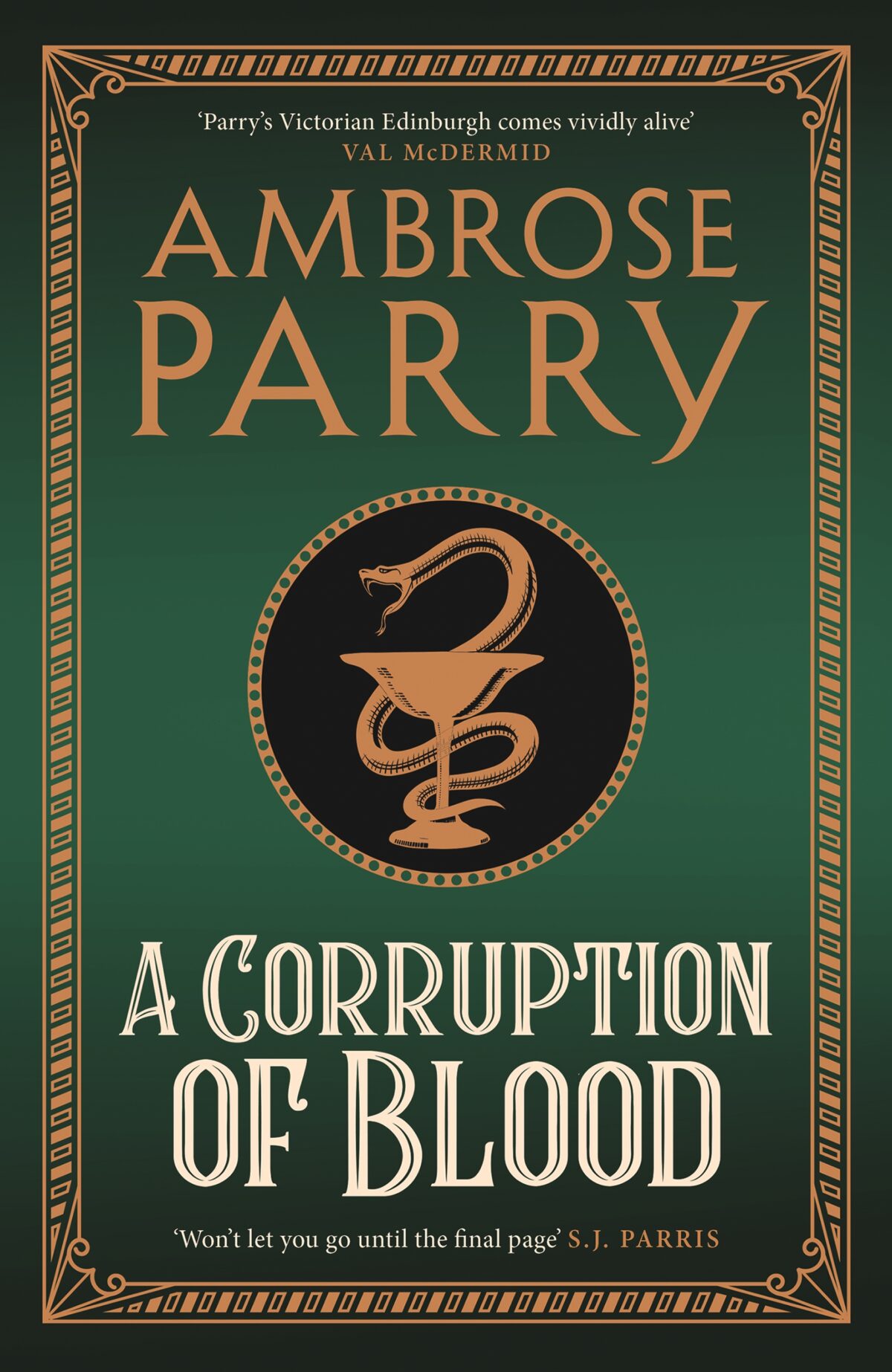
Scottish Crime Writing: A Corruption of Blood by Ambrose Parry
August 9, 2021The third in the gripping historical crime series featuring duo Will Raven and Sarah Fisher, A Corruption of Blood is a thrilling medical mystery set in nineteenth-century Edinburgh. We are delighted to feature the first two chapters of the book ahead of its publication on 19 August.
A Corruption of Blood
Publisher: Canongate Books
Publication date: 19 August 2021
ISBN: 9781786899859
Format: Hardback
Extent: 416 pages
Rights: World rights available, currently sold to Editions du Seuil in France and the US and Canadian audio rights to Recorded Books
Edinburgh, 1850. This city will bleed you dry.
Dr Will Raven is a man seldom shocked by human remains, but even he is disturbed by the contents of a package washed up at the Port of Leith. Stranger still, a man Raven has long detested is pleading for his help to escape the hangman.
Back in the townhouse of Dr James Simpson, Sarah Fisher has set her sights on learning to practise medicine. Almost everyone seems intent on dissuading her from this ambition, but when word reaches her that a woman has recently obtained a medical degree despite her gender, Sarah decides to seek her out.
Raven’s efforts to prove his former adversary’s innocence are failing and he desperately needs Sarah’s help. Putting their feelings for one another aside, their investigations take them to both extremes of Edinburgh’s social divide, where they discover that wealth and status cannot alter a fate written in the blood.
About the Author
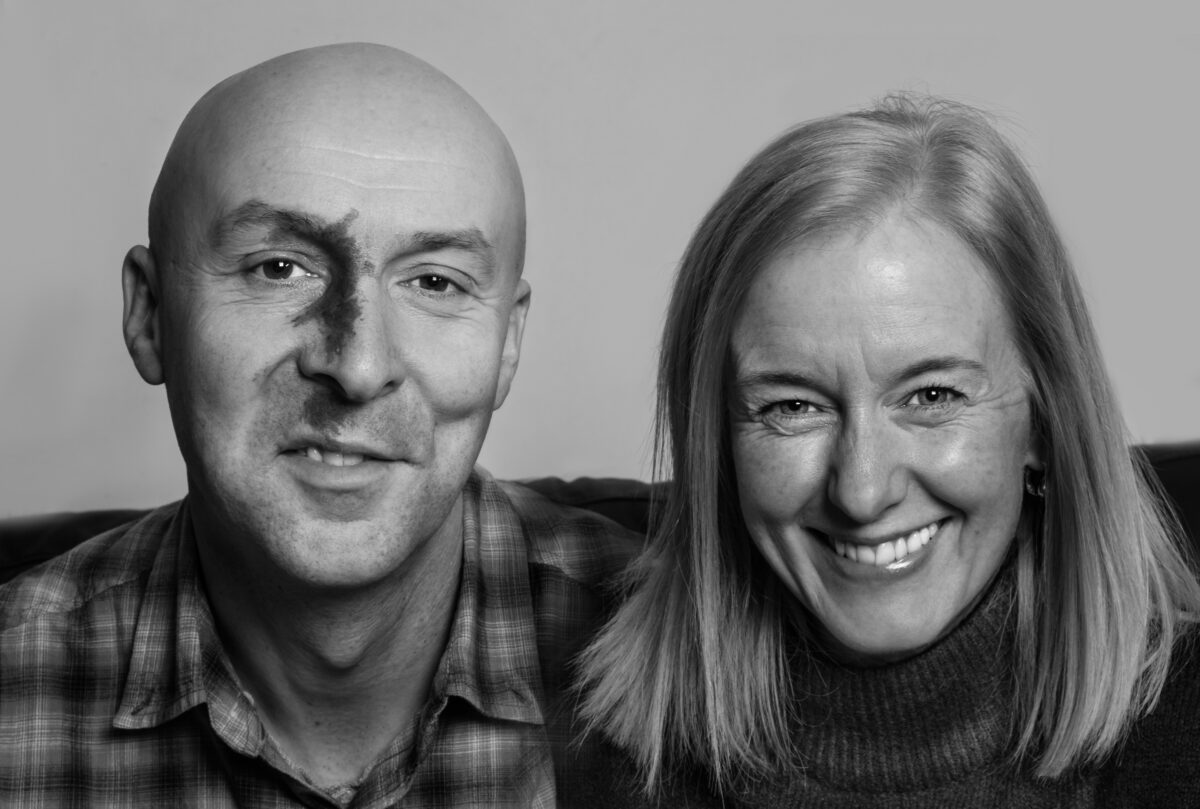
Ambrose Parry is the penname for two very different authors – the internationally bestselling and multi-award-winning Chris Brookmyre and consultant anaesthetist of twenty years’ experience, Dr Marisa Haetzman. Inspired by the gory details Haetzman uncovered during her History of Medicine degree, the couple teamed up to write a series of historical crime thrillers, featuring the darkest of Victorian Edinburgh’s secrets. They are married and live in Scotland.
Both The Way of All Flesh and The Art of Dying were shortlisted for the McIlvanney Prize for Scottish Crime Book of the Year. A Corruption of Blood is the third in the series.
You can follow Ambrose Parry on Twitter.
Author photo by Alan Trotter.
Extract
You can read the extract below or download it as a PDF.
One
A book is already written before the reader casts an eye upon the page. Its tale creates the illusion of uncer-tain outcome and myriad possibilities, when in truth all of its events are predetermined, unfolding in an ordered sequence that cannot be altered, only observed. Was this also true of each human life? Were our fates decided even before we were pulled screaming into the world: dictated by provenance and circumstance, by what our forebears could or could not grant us, and by what they were unwittingly forced to pass on?
Such were the thoughts of Dr Will Raven as he ascended a squalid staircase in Leith. His surroundings did not augur well for the child whose birth he had been called to assist. He wondered too what his own blood might harbour – a recurrent preoccupa-tion – and what the implications might be should he ever father a child himself.
The address he was looking for was in Old Sugarhouse Close, a ramshackle building situated beside the candle works. The air was full of the smell of tallow, the meaty stench of rendered animal fat. There were other, rawer scents too, with the flesh, fowl and fish markets abutting the factory. The last was always on the breeze, fish being a pervasive aroma this close to the port, as much a constant as the cries of the gulls.
Raven found the door that he was looking for and was about to knock when he heard the sound of crying. He paused. It was not the tormented screams of a woman in labour but the lusty bawling of a healthy new-born.
He sighed. Leith was a long way to have come for this. It did happen, of course. Uti veniebam natus: born before arrival of the medical attendant. It was a common enough entry in the outdoor casebook. The professor liked to say that he too had escaped the intervention of the local doctor in this way. Then, as always, Simpson had been in a bustling hurry to get on.
Raven rapped upon the door. He heard the scuffling of hasty footsteps and then it opened, a grey-haired woman standing before him cradling a naked infant in her arms, its skin still smeared with blood and vernix.
Raven held up his battered leather bag to identify himself.
‘I’m here for Mrs Corrigan, though I don’t suppose I need to ask if this is the right place.’
‘You took your time,’ the woman said.
He wondered if she was a local midwife. They had a tend-ency to resent the intrusion of doctors upon what they considered to be their territory. The meddlesome accoucheur with his forceps.
He smiled in what he hoped was a placatory manner.
‘Dr Raven. At your service.’
The woman stood her ground for a moment before stepping aside to let him enter. A short passageway led to two closed doors.
‘Where is the mother?’ he asked.
She nodded towards one of the doors. ‘In there. Afterbirth has still to come away.’
‘How long since the birth?’
‘A while.’
‘Could you perhaps hazard a guess as to the precise time?’
‘Not long.’
‘Has there been any bleeding?’
She looked at him askance. ‘There’s always a bit of blood when a child is born.’
‘I mean brisk bleeding. Flooding.’
‘I’d hardly be standing here talking to you if that was the case.’
He noticed a nautical chart hanging on the wall.
‘The father is a sailor?’ he suggested.
The woman frowned, giving the tiniest of nods, perhaps conveying that this was hardly a complex deduction given they were in Leith.
‘He is at sea now.’
‘When does he return?’
She rolled her eyes. ‘More of an if than a when, if you ask me.’ She lowered her voice. ‘It is Miss Corrigan,’ she added archly. Raven pushed open the door and entered a small room containing a bed and not much else. It was a familiar sight: a household that would struggle to feed another mouth.
He had often heard the voices of churchmen and politicians railing against the poor for having children they could not afford to feed and clothe. Ignorance was always fertile soil for the sowing of moral indignation.
The air had a clammy feel to it, humid and oppressive. There was a small window set into the wall above the bed but throwing it open would require scrambling over the patient lying in it. A thin sheet lay over her and the still prominent mound of her belly. Raven did not like what he saw. The uterus should have contracted more than that by now.
He put his bag down. Miss Corrigan had her eyes closed but her colour was good and her breathing steady. He gently lifted her hand and felt for the pulse at the wrist. Rapid but strong. Reassured, he spoke her name and introduced himself. She opened her eyes. He explained what he was going to do. She nodded.
Raven took off his jacket, rolled up his sleeves and then gently laid his hands on her swollen abdomen. Aware of the old woman’s eyes upon him, he opened his bag, took out his stethoscope and listened. He felt the uterus harden and then relax. He completed his examination by assessing the maternal passages and the cervix.
There was no other sound in the room. The baby, now consoled, was quiet.
The old woman tutted loudly. ‘Have you not done this before? Do you even know what you’re looking for? It’s like a bit of auld rope. Give it a tug and the afterbirth will likely come away.’
Raven looked at her and arched his brow. ‘Probably best if I deliver the other child first,’ he said.
***
The second twin, another girl, proved to be a straightforward delivery, and Raven required no assistance to deliver the after-birth. The old woman was still hovering, only briefly cowed by what she had missed and rapidly returning to her previous attitude of barely tolerating his presence.
Her surprise was as nothing compared to that of the mother, though. She seemed overcome, the shock of a second, unexpected child evidently not a welcome one. For those of narrow means, children could be a blessing or a curse. Additional mouths to feed could be offset by the ability of the youngsters to work and contribute to the family coffers should they survive early childhood. But two at once, with their mother’s ability to work hampered by having not one, but two babes to care for? Raven could not but fear for these little girls if this was their start in life.
At such times he consoled himself with the thought of Simpson’s humble origins, the seventh son of a Bathgate baker. Nobody had a choice over what they inherited, into which home they were delivered or what would greet them there: riches or poverty, love or cruelty, nurture or neglect. But Simpson proved that a man did not have to be defined by the start he was given.
To Raven’s mind, the corollary also held true. If you were born into wealth, it was not difficult to make your mark, and thus your achievements ought to be measured accordingly, but this was not a perspective shared by the rich. With a smile he recalled his friend Henry, back in their university days, speaking of a wealthy student given to diatribes condemning ‘the lowborn’ as somehow deserving of their fate: ‘He has the right to judge harshly, for he chose his parents well.’
When Raven emerged once more into Old Sugarhouse Close, the early summer sun was high enough to find him between the buildings. He put a careful hand to his pocket watch, mindful of the press of bodies he would have to navigate as he got closer to Leith Shore. There were subtle hands at work down here with a dexterity that would be the envy of any surgeon. The timepiece was the only thing of value that his father had left him, though he could hardly call it a bequest.
The crowd was thickening with every yard as he made his way along Tolbooth Wynd towards the Shore, indicating that a ship had recently docked. This had troubling implications for his chances of hailing a cab. He would probably have to walk. It was a pleasant enough day for it, but time was against him. Raven’s trip to Leith had left his new colleague, Dr Morris, to cope with the morning clinic on his own.
As he was calculating how quickly he could cover the distance on foot, and how much the extra time taken would add to the hostility of his reception back at Queen Street, he noticed that a small group had gathered at a quieter part of the quayside. They were looking over the side at something in the water. A man at the centre of the crowd was using a fishing pole to retrieve whatever it was that had fallen in.
It was a parcel of some kind. The fisherman’s rod bent as he raised it up, water pouring from its underside.
‘It looks heavy,’ someone said as it was carefully lowered to the ground.
‘Well, it’ll no’ be full of sovereigns if that’s what you’re hoping for,’ the man with the fishing pole replied.
‘Ye cannae know that until ye take a look.’
The fisherman snorted and shook his head. ‘As it was floating and no’ sunk to the bottom of the Forth, I can tell ye now it’s no’ full of gold coins.’
They all stood staring at the parcel. No one made a move to open it.
‘Smells a bit ripe,’ a woman’s voice said.
‘That’s cause you’re standing down-wind of auld Geordie,’ came the reply, producing a few titters of laughter from the crowd. The old man in question volubly cursed his accuser, provoking further laughter, but still no one seemed willing to approach the salvaged object, let alone open it.
‘Let me take a look,’ Raven said, holding up his bag. ‘I’m a doctor.’
As a physician he was well used to taking charge of a situation and dealing with things others found distasteful. The onlookers seemed happy enough to defer, parting to let him through.
As he reached the front, he caught a whiff of the odour leaching from the package and understood the hesitance of the crowd. He knelt down beside it, pulled a knife from his bag and carefully cut the binding. There were audible gasps from around him as he peeled back an edge of the paper, revealing a tiny hand. Reluctantly he peeled back some more, enough to disclose the head and torso of an infant: a human child wrapped up and tossed away.
The fisherman sniffed and wiped his nose on the end of his sleeve. ‘Told ye it wasnae treasure,’ he said.
Raven was seized by a surge of pity. As an obstetrician he had seen enough tiny corpses to be inured to the sight of another dead baby. He had held them while they were still warm, knowing no breath would ever issue from their lips even as their mothers looked on in hope. Yet something about this caught him unawares. Perhaps it was simply the fragility of the twins he had helped deliver that morning. He had feared for their start in life, but this served to remind him that for some there was no start at all.
***
Two
Raven’s return to Queen Street was delayed by having to wait for the police to arrive. Most of the onlookers had drifted away, leaving him to find a spot far enough away from the parcel that he was no longer disturbed by the smell. Without the distraction of conversation, he was left with his own thoughts for company. His mind returned to an earlier concern, and to the reason it felt imperative.
He had found the woman he wished to marry.
Raven had surprised himself with the strength of his feelings for her, feelings that for a time he had suppressed because he did not think their match would meet with approval. Of late, however, he had resolved to overcome whatever obstacles might lie in his path and allowed himself to truly contemplate the prospect of marriage. What he had long wished for was now within his reach. She was a woman with the knowledge and experience to assist him in his professional life, to help in the running of his medical practice, and she would wish to do so. She would not be content to be merely wife and mother. Nonetheless, he knew she would want to be both of those things too, and though Raven wanted children, he worried what he would pass on to them. Because every day he worried about what had been passed on to him.
You have the devil in you, his mother used to tell him. She had first said it in jest, later in worry. For they both knew where the devil had come from: whose blood ran in his veins.
You’re a useless mouth at my table, his father had been fond of telling him, a grasping hand forever in my pocket. He had seldom been content with verbal recriminations alone. At times Raven wished that his father could see what he had become – a doctor and assistant to the famous Dr James Young Simpson. More often he was grateful that he would never have to set eyes upon the man again.
Would his father have been impressed by his career thus far? A medical degree from the University of Edinburgh, furthering his education at some of the greatest medical institutions in Europe, and now assistant to the man who had changed the world through his discovery of the anaesthetic properties of chloroform? No doubt his father would have found a way to denigrate each and every one of these achievements. A bitter and disappointed man who would have been threatened by his son’s success.
Raven knew that his situation sounded impressive when spoken aloud, but he also knew this was mainly because proximity to Simpson placed him in the corona of the great man’s glow. Day-to-day practice was altogether less grand. Reality for Simpson included aristocrats and even royalty: patients travelling from around the world to stay in fine hotels on Princes Street, where they would wait for days or even weeks for a consultation. The reality for Raven was a trip down to Leith to deliver ill-starred twins and stand guard over a dead baby.
In time he was joined by a pair of constables tasked with transporting the little corpse back to the police office on the High Street for examination by the police surgeon. Raven gave his statement, which proved a prolonged task as the constable taking notes was excruciatingly slow in doing so. He struck Raven as the kind of fellow whose lips moved as he read.
‘When do you think the post-mortem examination will take place?’ Raven asked.
The constable shrugged his shoulders as he continued to scribble in his notebook, the tip of his tongue poking out between his teeth as evidence of his intense concentration.
Raven looked to his colleague, who was circumnavigating the parcel as it lay on the quayside. He had his hands clasped behind his back as though reluctant to touch the thing for fear it was dangerous in some way.
‘Up to McLevy, isn’t it,’ he stated.
Raven felt himself stiffen at the mere mention of the name. It was a common response, and one in which McLevy revelled. His reputation inspired fear throughout the city’s streets, except for those in the upper echelons of Edinburgh society who would be unlikely to ever feel the detective’s hand upon their collar.
Raven anticipated that McLevy would take charge of this latest grim discovery, unwilling to delegate such a matter to a junior member of his team. Nonetheless, Raven decided that he would like to be present at the post-mortem, his curiosity piqued. Unfortunately, he was not acquainted with the police surgeon, Dr Struthers, but his old friend Henry Littlejohn was now assistant pathologist at the Infirmary and assisted him on occasion. Raven was sure he would be able to prevail upon him for both introduction and invitation.
***
Raven arrived at 52 Queen Street damp with perspiration, a result of his brisk walk back from Leith in the strengthening sunshine. As he rushed through the front door, he very nearly collided with several bags piled up in the hallway.
He enjoyed a moment of elation, thinking that Sarah had returned despite her last letter indicating an extension to her travels – London, Paris and now Grafenberg. Then he saw Jarvis, Dr Simpson’s butler and general factotum, pick up one of the bags and take it into the professor’s study. He remembered that Dr Simpson had been off in the countryside somewhere, delivering the heir to a grand estate. No doubt the larder would benefit from gifts received in addition to the hefty fee: the largesse of a country laird grateful for the safe arrival of his child. The promise of game pie helped dispel thoughts of dead children and grudge-bearing detectives.
Lizzie, the housemaid, appeared at his side to take his coat and hat. She tutted loudly as she passed the garment onto Christina, the new girl standing at her side. Christina had not been with the household long, but was as diligent as she was uncomplaining, in contrast to her frequently simmering and occasionally terrifying colleague. Not that Christina was a cheery soul. The girl seemed burdened by a constant pall of melancholic gloom, which was unlikely to be lifted by working alongside Lizzie.
Lizzie pointed at the mud on his coat, acquired when Raven had knelt down to examine the parcel on the quayside.
‘You’ll have to take a brush to that,’ she told Christina. ‘Dr Raven has a tendency to pick up a great deal of dirt when out on his rounds. I’ve had to take that coat out the back with the carpet-beater before now.’ She gave Raven a stern look, daring him to contradict her.
‘What would I do without you, Lizzie?’ Raven replied. He had learned from experience that arguing with her seldom did much good.
She snorted and turned round, colliding with the luggage cluttering the hallway.
‘Don’t know why he bothers unpacking those bags,’ she said. ‘The professor is off again at the end of the week.’
‘Is he?’
‘London.’
Raven found it hard to keep up. Staying abreast of the professor’s activities was an impossible task. Simpson had at one point employed an amanuensis to order his affairs, but that had not ended well.
‘London,’ Christina repeated. ‘I’d love to go.’
Lizzie snorted again. ‘The only chance of you and me getting much beyond the outskirts of Edinburgh,’ she said, ‘is if we’re transported.’
As far as Lizzie was concerned that might well be true, Raven thought. He looked again at the new girl, who was now studying her shoes, possibly regretting that she had opened her mouth at all. She was young to have her modest hopes extinguished, yet how likely was it that her life would amount to much more than this?
Raven had just begun to flick through the pile of correspond-ence on the hall table when Hugh Morris stuck his head out of his consulting room. Dr Morris was also a recent addition to the staff at Queen Street. He was a decent sort, but a quiet, indus-trious type, always working, reading, writing papers, performing experiments in his room. He was not much for revelry or conver-sation. To Raven’s mind, occasional light-hearted distraction was essential when one was forced to contend with the diseased and the dying on a daily basis.
‘Difficult case?’ Morris asked, by way of acknowledging how long Raven had been gone.
‘Cases plural, as it turned out. Twins in the first instance, both delivered safe and healthy, but the next infant was not so fortunate. Found floating in the water at Leith.’
Dr Morris’s eyes bulged briefly. ‘And the mother?’
‘Currently being sought by McLevy.’
‘How thoroughly unpleasant. I wish I could offer respite, but . . .’
Raven nodded. There were still groups of patients clotted together at the door to the waiting room, a low hubbub of muted conversation from within.
Raven went into his consulting room and called for his first case of the day, which turned out to be an older lady full of gripes about the condition of the roads and the conduct of young people.
‘They do not show the proper respect for their elders any more,’ she grumbled, settling her ample posterior down on the examination couch like it was the assertion of a claim. ‘I had to wait an age for someone to give me a chair in the waiting room.’
Raven listened to her grievances as attentively as he could, before manoeuvring the conversation back to medical matters. He knew that sometimes the best medicine was a listening ear, that loneliness and isolation could contribute to a patient’s complaint, but this was not something at which he considered himself to be proficient. He could hear Simpson’s voice in his head as he struggled to concentrate: An unsympathising physician is a physician bereft of one of the most potent agencies of treatment and of cure. He knows not, and practises not, the whole extent of his art, when he recklessly neglects and eschews the marvellous influence of mind over body.
Simpson’s mantra had been repeated so frequently Raven could recall it without effort. He agreed with the principle but found its application a little more problematic.
He finally managed to coax from the woman the reason for her visit, asked the relevant questions, and made his examination of the crusted, scaly lesion that extended in patches from forearm to shoulder. He wrote out a prescription before applying a dressing and then a bandage to the worst affected area, congratulating himself on his patience and fortitude.
He handed her the prescription with a smile. It was not returned, the woman evidently not as impressed with his perform-ance as he was himself.
‘When is Sarah coming back?’ she asked flatly. ‘I generally prefer to be looked after by her. A lady is naturally more comfort-able being treated by another woman.’
‘Perhaps Sarah should obtain a medical degree then,’ Raven replied.
The lady looked askance at Raven’s handiwork, which he had to admit was not nearly as neat as Sarah’s would have been.
‘Yes, perhaps she should.’
As he watched her amble to the door, Raven knew that his patient was not the only one who was missing Sarah. It had been a month since she had gone, and the house did not feel the same without her.
Or was it simply that he did not feel the same without her? Aye, he would have to own that too.
There had been a time when he intended to make Sarah his wife, but he had not been sufficiently resolute until it was too late. In that respect, he had proven himself to be unworthy. He had let slip his chance through cowardice, concerned that marrying a housemaid would be injurious to his prospects. It took the pain of losing her to understand what she really meant to him: first when she married someone else, then when she had come so close to death.
As she recovered from her episode of ill-health, he had cast his plans. He would ask her initially to join him in setting up his own practice; then in time, once the appropriate decorum of widowhood had been observed, he would ask her to become something more. But on the very day he was preparing to broach the issue, she returned from visiting her husband’s grave and told him she wished to follow in the footsteps of Elizabeth Blackwell, the first woman to obtain a medical degree.
That was when a true epiphany struck him. Her circum-stances were profoundly changed. She was a widow now, with her late husband’s resources at her disposal. She was embarking upon a voyage of discovery, both physical and metaphorical, trying to find her place in a world that had suddenly become much larger.
Raven realised he could not make his offer: not because he feared she would reject it, but because he feared she would accept it. He could offer her a good life, far better than she might have dreamed only a few years ago, and she might well settle for that, but she deserved better. Sarah wished to be something more than a woman was usually permitted to be, and if he truly cared for her, he could not be the man who stood in her way.
The nobility of this often felt like small consolation as he watched her make her plans, and the hardest part was that he could not tell her any of it. But quite unexpectedly, by the time she was packing her cases, it had become easier: paradoxically because things had become more complicated.
He still cared for Sarah a great deal, but his feelings for her now had to be accommodated alongside his feelings for someone else.