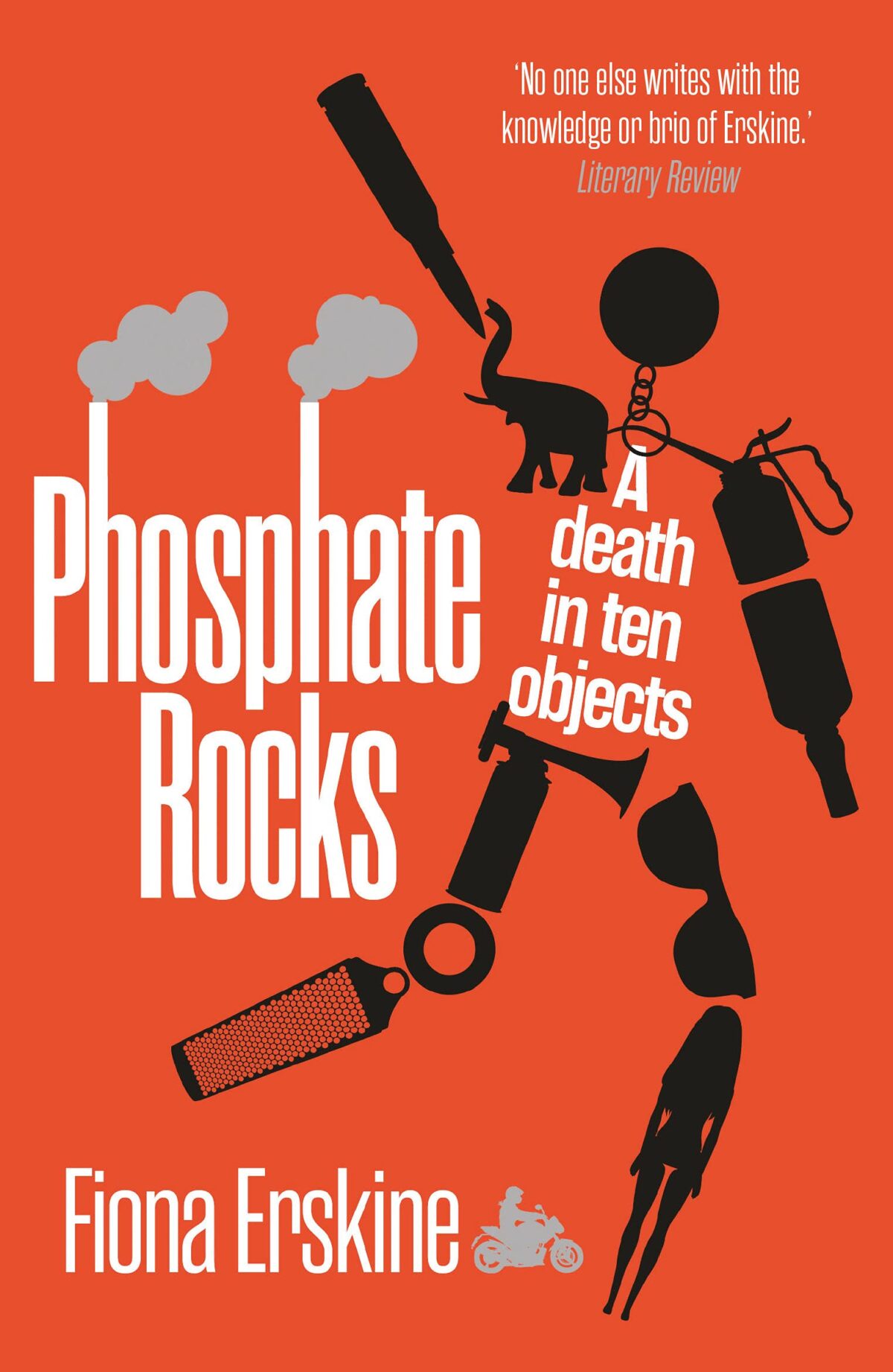
Scottish Crime Writing: Phosphate Rocks by Fiona Erskine
September 6, 2021A clever and inventive blend of memoir and murder mystery, Fiona Erskine’s Phosphate Rocks is a crime novel that defies genre. We’re so pleased to feature an extract from this fascinating book as part of our crime writing series.
Phosphate Rocks: A Death in Ten Objects
Publisher: Sandstone Press
Publication date: 17 June 2021
ISBN: 9781913207526
Format: Paperback
Extent: 288 pages
Rights available: World English (ex. Dramatisation)
Rights sold: Audio
‘An absolutely compelling read, clever and inventive, but with a deeply engrossing human story at the heart of it.’ – Lesley Kelly
‘A pacy murder mystery which also offers a fascinating insight into the workings of an industrial plant.’ – Undiscovered Scotland
As the old chemical works in Leith are demolished a long deceased body encrusted in phosphate rock is discovered. Seated at a card table he has ten objects laid out in front of him. Whose body is it? How did he die and what is the significance of the objects?
About the Author
A professional engineer with forty years of international manufacturing experience, Fiona’s first job after graduating from Cambridge University was in the factory described in Phosphate Rocks. As a female engineer, she is often the lone woman representative in board meetings, cargo ships, night-time factories and offshore oil rigs. Her first novel, The Chemical Detective, was published by Oneworld and shortlisted for the Specsavers Debut Crime Novel Award 2020.
Extract
You can read the extract below or download it as a PDF.
Introduction
In early 1988, I was rattling down Leith Walk on my Honda 90 motorbike (0–11 miles per hour in 1 millisecond, although it took longer to get above 11) towards Edinburgh’s dockland and the Scottish Agricultural Industries (SAI) fertiliser factory. I could tell what sort of shift it was going to be from the factory chimneys. My last one.
Five years previously, when I first informed the deputy manager that I planned to work shifts like the male graduates, he paled. A five-foot-three-and-a-half, sixty-kilo, twenty-something, cocky, over-educated feminist alone at night in a factory of hundreds of big, rough men… he was terrified for them. So, he appointed a trusted, experienced shift foreman to keep me out of trouble: John Gibson.
Many years and several jobs later, after a skiing accident and an even more bruising first brush with fiction, I was persuaded by my partner in life to write down the stories I used to tell arriving home from a twelve-hour shift in Leith docks, caked in phosphate rock.
I embarked on NaNoWriMo (National Novel Writing Month) armed only with the words ‘I remember’, and it all poured out.
NaNoWriMo is a bit like a Honda 90. You can race ahead with extraordinary speed and exhilaration; tens of thousands of words can be knocked out in a month. Unfortunately, it took me almost a decade to knock that first draft into shape.
The person I found it hardest to write about was John, my mentor and shift companion – enigmatic, infuriating, charming, capricious, obstinate, kind and wise – until I found a way to illuminate him by putting him centre stage, where he belongs.
Like the shaggy dog stories that John shared to get us through a night shift, not all of what follows is exactly true. Names have been changed because the real people involved are still bigger than me. Dates have been changed because my memory is appalling.
I am going to pop up from time to time, like the James Gillespie’s High School and Cambridge University educated smart arse I am, to explain some of the technical stuff. You’ll be able to spot me by the thud of Perry’s 4.46-kilogram Chemical Engineering Handbook (Version 6), the motes of dust (atishoo!) and the rustle of its 2,240 pages.
Inspired by Primo Levi, in the style of Dan Brown, this is the portrait of a factory in all its complex, glorious, interconnected, messy entirety. A hymn to the forgotten, the unknown and the misunderstood, this is the story of a fertiliser factory in decline and some of the fine people taken down with it.
I asked John to read this, to see if he wanted to change anything. He refused to even look at it.
‘I trust you, doll,’ he said.
Doll?
OK, then. Gloves off. Carte blanche.
***
One: Demolition
The demolition crew found the body.
A gale blew across Leith docks, drowning the rumble of bulldozers, squeal of hydraulic scissors, juddering percussion of jackhammers and crash of falling masonry. Gusts of wind whipped the concrete dust into weird shapes: mini tornadoes with tentacles and claws, ephemeral and monstrous.
The abandoned SAI fertiliser factory occupied a promontory of land reclaimed from the Firth of Forth, a fenced site that stretched two miles east–west and half a mile north–south on the edge of the Port of Leith, Edinburgh’s dockland. Little remained above ground. The offices and stores, tanks and reactors, towers and chimneys had been reduced to shards of broken brick, jagged concrete wedges, spaghetti junctions of metal pipe and beam. The demolition forces, a phalanx of specialised destruction machines, trundled towards the last remaining structures above the deep-water dock. The mechanised locusts munched through the factory, flattening everything in their wake, leaving behind a wind-blown desert: order to chaos, symmetry to entropy, meaning to insignificance.
Kelly was driving the grapple, a hydraulic excavator with an articulated jaw in place of a digging bucket. Steel teeth chomped through the covered aerial conveyors which had once transported powdered phosphate rock on huge rubber belts to the heart of the factory. The grapple left a trail of carnage to be sorted and shifted.
From inside the ‘hoose’, a cab on a rotating platform above the moving undercarriage, Kelly manoeuvred the grapple gingerly towards the edge of the quay, alert to the sharp smell of seaweed. One false move and the bright yellow juggernaut with its crawler feet and long giraffe neck would topple into the North Sea. Even if he escaped from the hoose, the freezing water would kill him before they could fish him out of the shipping channel. Journey’s end.
Kelly attacked the final structure, an elevator tower designed to raise the ship’s cargo from quay to conveyor. Rat-a-tat-a-tat-rat-a-whoofffFFFF. The walls of the intake elevator collapsed under Kelly’s assault and a cloud of rose-gold confetti mushroomed and shimmered above the ruin. As the dust cleared, he edged forward, peering through the grimy glass of the cab at the exposed elevator shaft, grapple poised, one hand on the joystick, ready to rip its guts out.
Something stayed his hand. He couldn’t say exactly what. A lull in the wind? A break in the clouds? The plaintive cry of a gull that sounded almost human? A shaft of sunlight illuminated shapes beneath the metal structure. Scratching his head, Kelly flicked the windscreen wipers to nashing and matched the stroke with a squealing rag on the inside of the glass. He peered through, swallowed hard, and stopped the machine.
Angry Pat responded to the radio call, stomping over the rubble, bellowing obscenities. The demolition crew foreman followed the new yodelling school of management. What started out as a quiet transaction in a warm office, a contract signed with just the scratch of a biro on smooth paper, was amplified over time into a series of increasingly strident shouting matches. Angry Pat was the last in the line of yodellers. Having received his instructions over mountains of obstacles, across gulleys of incomprehension, he passed them on by haranguing with ever-increasing ferocity and volume, berating men who valued their jobs too much to shout back.
Kelly ignored the tirade, as he ignored most of the invective that spewed from Angry Pat, and nodded at the ruined tower. Crumbs of concrete dangled on threads of steel reinforcement bars. The elevator, a tangle of buckets and chains, was listing to one side, the flimsy floor had been torn apart to reveal the machine room below. A metal ladder led down past a huge pulley wheel into a deep basement. Directly underneath the wheel, a conical mound of powdered rock had formed, undisturbed for years, most likely, but now slowly collapsing, like a sandcastle at high tide. With a grimy finger, Kelly pointed to the unmistakable shape of a human head which had emerged from the settling pile.
‘Jesus Christ!’ Angry Pat backed away, eyes wide.
The job had a tight schedule. The old fertiliser factory on the docks had to be razed to the ground before the area could be redeveloped as a shopping and entertainment centre. It was a fixed-price demolition contract and they were already over budget. Angry Pat hesitated, looking sideways at Kelly with an unspoken request. Kelly turned away and spat into the sea.
The foreman’s shoulders slumped. ‘Virgin Mary’s bollocks.’
He phoned his boss before he called the police.
***
It took days to sift through the rubble. The police impounded the demolition equipment, machines too crude for delicate excavation. The crew were laid off; no other jobs would take lone men who were only as useful as the snippers and dozers and grapples they operated. Kelly remained on half wages to hang around and guard the kit.
New machines arrived: tiny grabbers and sifters, with hoses and sniffer snouts, followed by men and women in white overalls with brushes and bags who took care not to disturb the body, hand-digging to preserve as much evidence as possible.
Kelly made it a rule to stay well clear of the police, but the woman in uniform tracked him down to the store where he took naps between security shifts.
‘Detective Inspector Rose Irvine.’ She announced herself with a rap on the door of the windowless lock-up. ‘Can I have a word?’
He rubbed the sleep from his eyes and ran fingers though tousled hair, catching an unpleasant whiff of his own oxters.
She waited for him to emerge and lock the door before she marched back to the crime scene. He stopped to take a leak behind one of the huge rubber tyres, zipped himself up and followed.
‘You the lad that found… this?’ She nodded towards the vault where a police photographer was fiddling with his camera.
‘Aye.’
He paused at the lip of the crater. A vacuum truck had sucked away the last of the powdered rock, and Kelly let out a gasp as he took in the scene below.
Everything in the basement under the elevator pulley was encased by a thin shell of hardened phosphate rock, creating a macabre tableau. The human figure could be seen clearly now, seated on a chair, the body upright, hands resting on a rude desk, fingers splayed as if pointing to several objects on the flat surface. The head, the body, the furniture and the objects, perfectly preserved.
‘Tell me exactly what happened.’
‘I already told the polis—’
‘Tell me.’
He reappraised her. Not one to mess with, for all she looked like a wee clootie dumpling. But there was little enough to tell. He translated the technical terms of demolition into lassie-speak as best he could.
‘Looks almost staged,’ she said.
He shook his head. ‘Whoever it was, they lived there.’
‘How do you know?’
Kelly pointed to the braziers. On either side of the seated figure stood two perforated 50-gallon drums, the tops hacked off to leave jagged steel edges, multiple saucer-sized holes punched through the sides. The sort of luxury item working men rely on for heat during winter jobs.
‘Who is it? How did this happen? Any ideas?’
Kelly shook his head. He had no clue, but he knew one person who might. A man who knew everything that ever went on in the old factory.
‘You’d best talk to John.’
***
Two: John
John has a face like a well-kept grave.
He arrives early one morning at Torphichen Street Police Station: a tall, thin man with cropped grey hair and the demeanour of a professional undertaker. He is neatly dressed in polished leather shoes, grey trousers with stay-press seam, an ironed white shirt, blue tie and burgundy V-neck jumper under a padded anorak. Despite the layers, he shivers in the slanting winter light and blinks repeatedly as he states his business at the counter.
‘I’ve come about the ess-eh-eye.’
A short, plump woman emerges from a side room with outstretched hand. She wears a black serge uniform with silver buttons and epaulettes, fair hair scraped back from a round face.
‘Mr. Gibson?’
She smells of flowers and reminds him of summer.
‘Aye.’
‘Detective Inspector Rose Irvine.’ Her handshake is warm and surprisingly firm. ‘Thanks for coming in.’
He follows her up a flight of steps and waits while she recovers her breath. Outside Interview Room Number Two she gestures for him to enter, but he holds the door open so she can go in first.
The room is furnished with a wooden table and four metal chairs, the furniture marooned on a sea of blue linoleum, adrift between plain grey walls under a high barred window and a ticking clock. On the table is a manila folder.
‘You worked at the SAI?’ she asks. ‘Scottish Agricultural Industries?’
‘Aye.’
‘We found a body in the old Leith works.’
John places his hands flat against the table, leaning onto it for support.
‘Sit,’ she says. ‘Please.’
His complexion has paled from ivory to ash, his breathing is fast and ragged. She observes him closely as he sinks onto the chair.
When he raises his eyes again, they are wide with shock. ‘Who is it?’
‘We don’t know yet,’ she says.
‘Poor beggar.’
She leans forward. ‘Any idea why there might be a dead body in your old factory?’
‘No.’ He shakes his head.
‘Until I get the autopsy results, I don’t know the date of death, the cause of death, whether the victim was male or female, young or old, tall or short, fat or thin.’ She sits back and stretches her hands out, palms upwards. She has nice hands, capable hands. ‘Can you help me?’
‘I can try.’
She opens the folder and shows John the photographs. ‘What can you tell me?’
His shiver turns to a shudder. ‘Poor beggar died before 1997.’
‘Why do you say that?’
John wrinkles his brow. ‘Production stopped.’
‘I see.’
‘And after 1955,’ he adds.
‘When production started?’ She frowns. ‘A forty-two-year window?’
He nods.
His working life.
***
First Clue: The Ebony Elephant
Sulphur
Three: The Ebony Elephant
Inside the interview room of Torphichen Street Police Station, Rose is the first to break the silence.
‘Can you identify the items found beside the body, the things on the desk?’ She extracts a photograph from the manila folder and hands it to John. ‘Here’s a close-up.’
He takes off his glasses and brings the print to the end of his nose.
‘We cleaned the objects up,’ she says. ‘Do you want to see them?’
‘Aye.’
She picks up the phone and punches a number. ‘Bring in the SAI evidence.’
Please, he thinks to himself.
‘To Interview Room Two,’ she says. ‘Right away.’
Thanks, he adds silently as she puts down the phone. After all, it doesn’t cost anything.
At a knock on the door, he is first on his feet, opening the door for a young constable who carries a metal tray.
Rose nods at the table, and the constable rests the tray carefully on the near edge.
John moves the stack of photographs to one side so she can slide it into the centre.
‘Thank you,’ she smiles.
‘You’re welcome,’ he says.
Rose waves the constable away.
John sits again. He stares at each of the objects for exactly ninety seconds, one after the other, then closes his eyes.
Rose waits.
The clock ticks.
Rose waits some more.
When he opens his eyes, she leans forward. ‘Any ideas?’
‘Can I touch them?’
She nods.
John picks up a little ebony elephant, about the size of his fist, tail curved, trunk down, ears alert, expertly carved. He strokes the smooth wood. One sharp white tusk is loose. John pulls it out, brings first the matchstick-sized shard, and then the empty socket, to his nose. He sniffs. Once. Twice. He pulls away and licks his lips, wrinkles his nose then bends forward and inhales again. Thrice.
Yes, there it is. No doubt about it. Just a trace, a whiff, but unmistakable.
Sulphur.