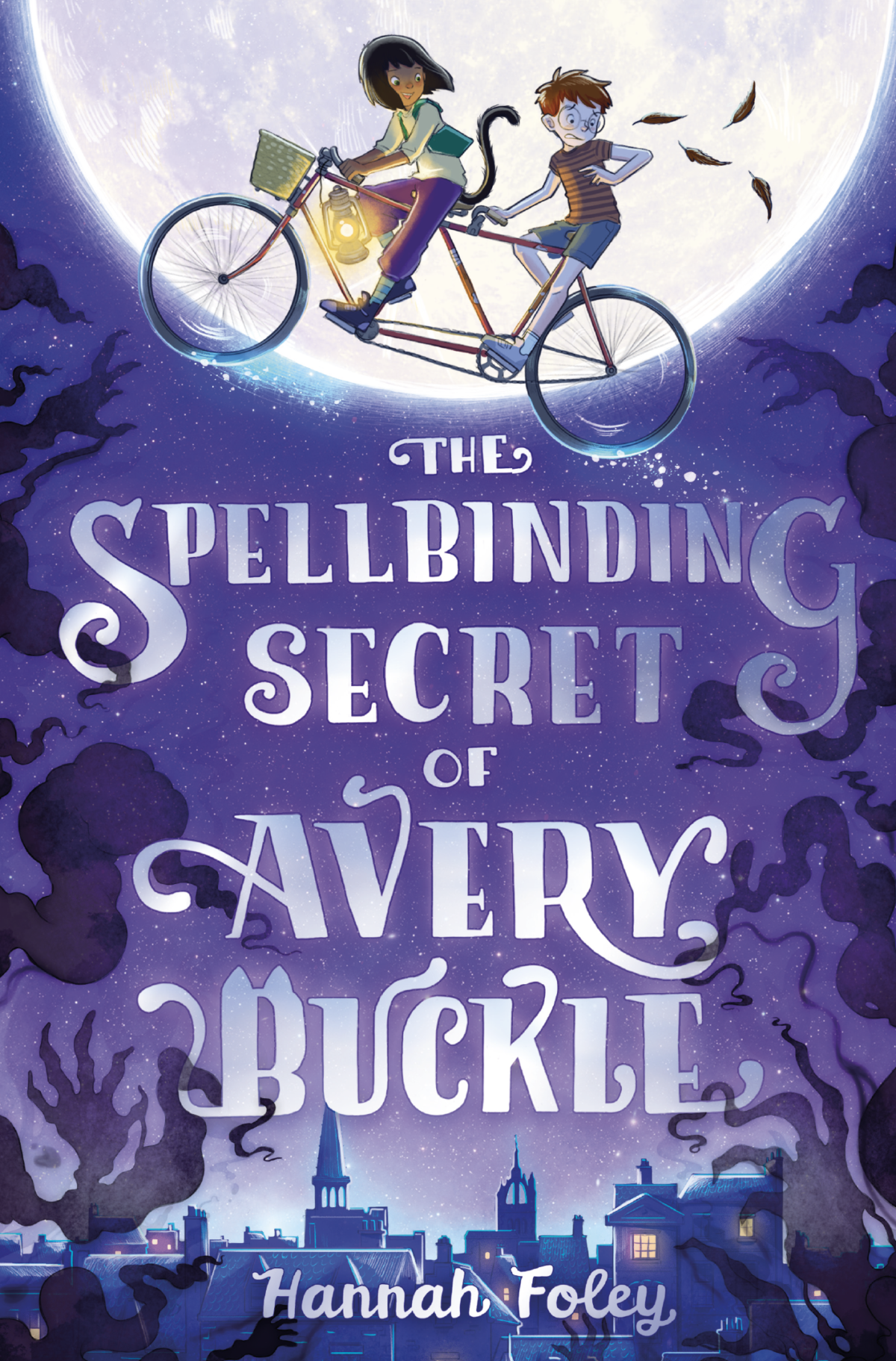
Scottish Debuts: The Spellbinding Secret of Avery Buckle by Hannah Foley
May 14, 2021Winner of the Kelpies Prize, Hannah Foley is a sparky, imaginative new voice in children’s middle-grade fantasy. Her debut novel, The Spellbinding Secret of Avery Buckle, was published by Floris Books in March 2021. We’re delighted to feature a blog post from Hannah – detailing her life as a writer and a district nurse during the pandemic – as well as the first chapter of her book.
The Spellbinding Secret of Avery Buckle
Publisher: Floris Books
Publication date: 18 March 2021
ISBN: 9781782506409
Format: Paperback
Extent: 208 pages
Rights: World
Avery Buckle has always been different: part girl, part cat, and entirely confused about where she really belongs. But it turns out her tail isn’t her biggest secret .
Plunged into an extraordinary world of witches, enchanted libraries and fantastical creatures, Avery discovers only she can stop a dark force from being unleashed.
But with a powerful enemy on her tail, can Avery save the magical world and find out who she really is?
About the Author
Hannah Foley grew up in Devon and worked as a registered nurse for a number of years before returning to school to study illustration at Edinburgh College of Art. She is now a freelance illustrator living in Devon, illustrating for children, young people and families in the educational and charitable sectors. Hannah loves creating narratives with both words and pictures. hannah-foley.co.uk / @Han_Foley
Watch Hannah read an extract from The Spellbinding Secret of Avery Buckle below:
Blog Post
At the beginning of 2020 I was looking forward to my debut children’s novel, The Spellbinding Secret of Avery Buckle, being published. As the early months of the year passed, it quickly became clear that I’d be waiting longer than anticipated. The world was being turned upside by a vicious virus called Covid-19. As the UK went into the first lockdown, bookshops, libraries, and schools everywhere closed their doors. The decision was taken to delay publication and my day job went into overdrive…
When I’m not writing children’s novels I work as a district nurse, providing healthcare for housebound patients and care home residents in the community, ranging from dressing wounds, management of long-term conditions, to care of the dying. Every one of my patients fell into the highest risk category for Covid-19. Armed with layers of PPE, even the smallest of tasks now became a major operation. And in the warmest year on record, doing my job gowned up, almost head-to-toe, in plastic, I sweated more than I’ve ever done in my life! But it has been odd too, because, although I have been incredibly proud to be able to use my healthcare skills during the pandemic, my storytelling skills suddenly didn’t seem to matter all that much. For a while there, it was easy to feel that the only parts of my identity that counted were being a nurse and being a homeschooling mum.
I know I’m not the only one to have felt that way. While the nation clapped for carers, the creative sectors were being decimated, and artists were being asked to re-train in areas deemed ‘essential’. The wonderful booksellers and librarians I’d been working with on ideas for book events were suddenly furloughed, or grappling with moving online, and often literally up to their eyeballs packing postal orders. The intense pressure on the book community was tangible, even for a relative newcomer like me.
But one of the unexpected things about that first lockdown was that book sales soared, and the children’s book market remained buoyant. Just as our ancestors have done for thousands of years, in the darkest of times, we turned to stories to help us through. The heroic effort of booksellers and librarians getting books into people’s hands turned out to be very much ‘essential’. And while I wasn’t (yet!) celebrating the publication of my first book, stories were keeping my patients and me going too.
It might surprise you to learn that stories are at the core of nursing – the stories of how people got to where they are, and why, and what they imagine the future holds. It is often through listening to these stories that nurses best help people to address their health needs.
But of course, it’s no use sitting down with someone, pen and paper in hand expecting it to all pour out. These complex and most profound of stories unfold over time, visit after visit, as a nurse bathes a person’s weeping leg sores, or supports them in the last days of their life. During the pandemic, as people’s social support dwindled due to the restrictions on mixing households, district nursing teams have often been the only other soul a person has seen for days. It’s not the same as cranking up a ventilator in an Intensive Care Unit, but taking the time to listen to my patients’ stories, and sometimes to share my own, has been another form of life support for so many.
So, although my focus changed last year, from launching my debut novel to nursing in my community, stories are still at the heart of what I’m doing. Now more than ever, I’m incredibly proud to be part of the book community, rising to the challenges posed by Covid-19, and keeping people going through the power of words.
Extract
You can read the book extract below or download it as a PDF.
Chapter One
Sprinting out of the school building, Avery Buckle jumped nimbly onto the high brick wall that circled the playground.
“I wish you wouldn’t do that,” said Low, running to meet her.
Low was Avery’s best friend.
“This?” asked Avery, skipping along the top of the wall.
“You’re going to fall!” Low called with a gasp, as she leapt gracefully across an open gateway and landed on the other side. “Where have you been? I’ve been waiting for you.”
“Sorry, I got detention.” Avery gazed down at him from under her thick black fringe. Her wide eyes were an unusual yellowy green.
“Another one? Let me guess… fidgeting and not sitting still again?”
Avery nodded and made a face. She paused and squinted down the street. Her warm brown skin cooled a shade. From the corner of her eye, she thought she had seen something moving in the shadows. Up on the wall she could see to the far end of the road in both directions, right down to her house at the bottom. It was October and the daylight was fading. Lights blinked on in houses as people returned home from school and work.
As the year had passed into autumn, and the evening shadows had lengthened, Avery had had a growing sense of being followed. It had just been an uneasy feeling to start off with, a prickle down the back of her neck, but it had been mounting and today she was sure that someone, or something, was lurking in the darkness down the street.
She peered into the dim distance but saw nothing. Taking a deep breath, she tried to slow her racing heart, pushing her hand into her pocket and closing her fingers over the objects nestled there: a rounded piece of sea glass and a small old guidebook with a fold-out map. Immediately her panic eased and a funny glad feeling filled her heart.
“Pleeease come down, Avery,” pleaded Low nervously. He pushed his glasses back up his gingery freckled nose.
Avery gave the street one last look and sprang onto the pavement below, smoothing her hair with her hands. Her thoughts turned back to her detention. “Don’t you ever want to find somewhere you can be yourself, Low? Somewhere you don’t have to sit still if that’s not who you are?”
“What do you mean?” he asked, hopping about on one foot. “I am myself.”
But I’m not, Avery wanted to say.
“Cheer up,” called Low, puffing on ahead on his short legs. “It’s the Halloween disco tonight.”
Avery bounded after him. “Why won’t you tell me about your costume?” She had no idea why Low had decided to be so secretive this year.
He shook his head with a smug grin. “You’ll have to wait and see!”
“It’s not fair, you know what I’m going as.”
“That’s because it’s always the same thing.”
Avery stopped outside her front door. Number 58 was no different to any of the other red-brick terraced houses in the street. Frilly net curtains hung at the window and on the sill was a trough of yellow pansies, cheerful in the late afternoon gloom.
Low ran on. “See you there!”
She watched him jog away, his messy tawny hair just visible above his enormous rucksack. It was no doubt full of books, as always. It bumped up and down on his back dangerously, threatening to topple him at any moment.
Avery let herself into the house. The warm scent of baking enveloped her as she dumped her school bag on the hall floor and kicked off her shoes.
“Is that you, sweetie?” Cindy’s voice wafted from the kitchen.
“Yes, it’s me!” Avery called back with a roll of her eyes. Who else would it be?
“Come through and tell me about your day. I’ve baked cookies!”
“It’s been okay,” began Avery, walking into the kitchen. “Detention was kind of annoying—” She stopped mid‑sentence.
“Never mind, chick. Look, I’ve ironed your knickers for you,” crooned Cindy, holding up a pair of neatly laundered pants.
“No ironing knickers!” cried Avery. “How many times have we been through this, Cindy? Shirts, yes. Knickers, no!”
Cindy was tall and slender with long delicate hands and dyed golden hair, blow-dried into a fluffy ball. It being Thursday, she was wearing her blue house jacket. She always wore one to protect her clothes when she was cleaning. She had a different colour for each day of the week. Cindy liked everything to be so pristine it gleamed, but that didn’t explain why she herself sparkled faintly under the kitchen lights.
Though Cindy tried hard to be like a mother to Avery, nothing could change the fact that she was just a magic spell. A guardian spell conjured to look after her.
Avery sighed.
“Welcome home, sweetheart!” Bob popped his head around the kitchen door, beaming broadly. He had short grey hair and wore spectacles that seemed too small for his round face. Large and jolly, he loved two things: his unusual collection of cheese graters – which he spent a great deal of time polishing – and bad jokes. Like Cindy, Bob shimmered softly under bright light.
“I’m going upstairs to get changed,” Avery said quickly, before he could test any of his terrible jokes on her. “It’s the school Halloween disco tonight, remember.”
“Righto, chick,” said Cindy. “Oh, another one of those packages arrived for you. I’ve X-rayed it, and it’s nothing dangerous.” Cindy closed her eyes and hummed quietly to herself as she waved her pale hand over a small parcel wrapped up in brown paper and tied with string. She opened her eyes. “Yes, definitely safe. Always worth a second check.” She smiled brightly and handed Avery the package.
Avery frowned at Cindy but said nothing. She took the parcel and headed upstairs. Who X-rays every bit of post that comes through the letterbox? A magical pretend parent, that’s who.
Once in her bedroom, Avery laid the package on the bed and traced the swirling handwriting with her finger: Avery Buckle. It was the sort of writing you found in old books, full of delicate flicks and curls. There was an inky postmark on the parcel in the top right corner that she couldn’t quite make out, but no stamp or address. It was very odd. How had it got here?
It had been the same with the mysterious parcels that had brought her the sea glass and the guidebook. There had been no note with them, and no sign of who sent them. The sea glass was frosted white, but looked no different to glass that anyone could pick up on beaches the world over. The edges of the little guidebook curled with age and were mottled with brown specks. It was the sort of thing you might find in a second-hand bookshop. It described a district of Edinburgh called Canonmills. Avery had never been to Scotland and didn’t know anyone there, so there was no reason for someone to send her such a thing.
Carefully untying the string on the new parcel, Avery ripped the paper away to reveal a small round object, brown and wrinkled. A peach stone.
Someone had sent her a peach stone.
She pulled the sea glass and the guidebook from her pocket, holding them in one hand and the peach stone in the other. There it was again: that funny glad feeling. She couldn’t say why, but when she touched this strange collection of items, she felt her whole body flood with a comforting kind of warmth.
Avery rummaged amongst the torn paper but couldn’t find a note. Who was sending her these things? And why? They’d started to arrive around the same time that Avery had first felt she was being followed. Was that connected, or just a coincidence?
Maybe her real parents had sent them? Avery had never known her mother and father. As far back as she could remember she had lived with Bob and Cindy, two spells conjured up by who knew who to take care of her. Both Bob and Cindy had always been completely honest on that front.
“What exactly are you?” Avery had first asked them when she was very small.
The answer was always the same. “We’re magic!” Bob would beam. “Our job is to look after something or someone very precious. We look after you.”
“And you have absolutely no idea who conjured you up?” Avery would ask.
“Not a bean!” they would reply. “You’ve been put here with us to keep you safe, so keep you safe is what we do.”
“Safe from what? And are you sure you don’t know who my parents are?” Avery would persist.
“Not a clue on either count, I’m afraid.” Bob would shake his head, but Cindy would look at Avery sadly.
“Were, we don’t know who your parents were, Avery. You’re the last of the Cat Fae, and if you’re the last, it stands to reason there can’t be any others.”
“But you don’t know that, do you?” Avery would say stubbornly. “And what exactly is a Cat Fae anyway?”
“Oh well, that’s easy,” Bob would nod. “A Cat Fae is you. Part-human and part-cat – but entirely special.”
And that was the nub of it, because being brought up by two spells wasn’t the only unusual thing about Avery Buckle.
Avery had a tail, a long black furry tail, which she kept carefully hidden away.