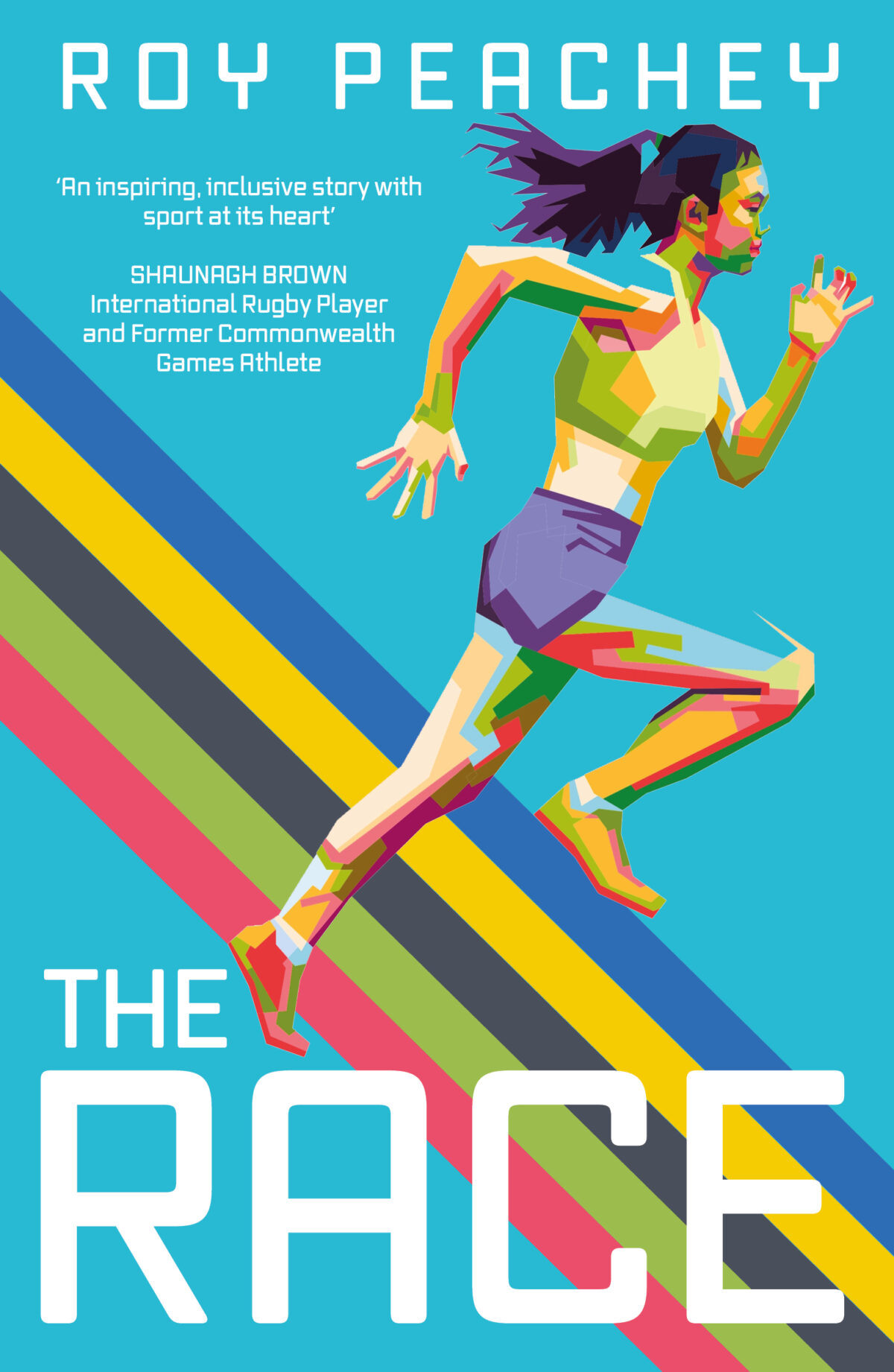
Scottish Debuts: The Race by Roy Peachey
May 21, 2021An inspiring dual narrative about sport and perseverance, The Race by Roy Peachey is coming out on 3 June from Cranachan Publishing. Read the first chapter of this wonderful tale below!
The Race
Publisher: Cranachan Publishing
Publication date: 3 June 2021
ISBN: 9781911279839
Format: Paperback
Extent: 200 pages
Rights: World
‘An inspiring, inclusive story with sport at its heart.’ – Shaunagh Brown
Two countries. Two athletes. One goal.
12-year-old Lili is determined to defeat her arch rival in front of the Queen during her school’s anniversary celebrations. Adopted from China as a baby, Lili also has personal challenges to overcome, but when her training is thrown into chaos by events outside her control, she realises that she must choose between family and the race of her life.
Meanwhile in 1944, Eric Liddell, hero of the 1924 Olympics, finds himself in a war zone. Separated from his family, he is getting ready to run his final race in a prison camp in China when his lifelong principles are challenged by the imprisoned children he is trying to help…
About the Author
Roy lives with his wife, two daughters, two dogs, two cats, one rabbit, one tortoise, and a few fish. When he isn’t spending time with his family, writing books, or looking after the menagerie, Roy is a teacher.
Peachey’s first novel for adults, Between Darkness and Light, the story of a translator with the Chinese Labour Corps during World War I, was published in 2019 by Eyrie Press. He is also the author of three non-fiction books: Out of the Classroom and Into the World; 50 Books for Life; and Did Jesus Go To School?
The Race is his debut children’s novel.
Extract
You can read the book extract below or download it as a PDF.
Chapter One
Lili
It was Wednesday afternoon and Tom was being annoying.
Tom is annoying most days but that afternoon he was being really annoying. I think it’s because he was bored. We were in school, which was kind of OK, and we should have been having Sport, but it was pouring with rain, so we had to stay inside.
I think we should have gone out anyway but the teachers said it wasn’t safe, which seemed odd because we run around at break whether it’s raining or not. The teachers aren’t worried then and no one ever gets hurt. Well, not often anyway. And what does it matter if we do get wet? Our skin’s waterproof. That’s what my Gran says and she’s pretty much always right.
So, it was raining and we were cooped up in a classroom, learning about the history of the Olympics when we could have been outside doing actual sport. That’s why Tom was being annoying.
‘Where did China come in the medal table at the Rio Olympics, Miss?’ he called out.
The problem with Tom is that he’s actually pretty clever. He’s annoying, of course, but he’s also smart. I hate to admit it but it’s true. He knew where China came in the medal table. That’s why he was asking.
‘Good question, Tom,’ Miss Scattergood said. ‘I can’t quite remember off the top of my head but let’s check, shall we?’
I like Miss Scattergood, I really do. She actually listens to what we say and she’s got a great collection of purple glasses, but she is a teacher and teachers have a very funny way of speaking. Every question’s a “good question” and “let’s check, shall we” really means “I’ll google it.” If I ever become a teacher I’m going to speak normally.
I sat back in my chair and waited for Miss Scattergood to work out how to get connected on the school laptop. I avoided Tom’s eye but there was no escaping him really. In every lesson there was always a vague sense that Tom was there, that Tom had been there, or that he was about to appear.
The maps of the world that we’d made last term were a case in point. The purpose of the exercise had been to show that there are different ways of presenting a 3D world in 2D form, but Tom had taken the opportunity to cause mischief as usual. Sophie and Rachel had drawn an enormous Greenland, like the one Miss Scattergood showed us on her Mercator map. Andy and Todd had added a super-large India and my contribution was to put China slap bang in the middle, just like Chinese map-makers used to do. And why not? Why shouldn’t China (or India or Greenland, for that matter) be in the centre?
But Tom couldn’t cope with China in the middle of the world, so he carefully cut round it so that when Miss Scattergood picked up the map to show the class, China promptly fell to the floor. Tom and his idiotic friends thought this was hilarious. We stuck it back together afterwards but it was never quite the same again.
‘Oh, here it is,’ Miss Scattergood announced, interrupting my thoughts. ‘They came third.’
‘And who came second, Miss?’ Tom asked. He’s so predictable.
Miss Scattergood checked her screen.
‘Well, it was Great Britain. That’s good, isn’t it?’
‘You’d think the Chinese would’ve done better than third, wouldn’t you?’ he said, half turning so I could see the snarky look on his face. ‘There are so many of them.’
Snarky is a good word. It means cranky or cutting. My Gran taught me what it means. She said it might come in useful. She said it’s a word teachers should use more often, especially when they’re talking about Tom.
‘I think China did very well, Tom. And so did Team GB. They both did very, very well.’
‘But China didn’t do well, did they, Miss?’ Tom insisted. ‘We beat them. And that’s what sport’s all about, isn’t it, Miss? Not being a loser.’
‘Sport,’ Miss Scattergood said, changing her tone of voice and piercing him with a steely look now that she’d worked out what he was up to, ‘is all about taking part. So let’s get on with the lesson.’
Actually, I wasn’t bothered that Britain got more golds than China because I’m Chinese and British. That means I get to support two teams at the Olympics. Britain won 27 gold medals and China won 26. That means my teams won 53 gold medals, which put them in first place. The USA only got 46, so they’ve got a lot of catching up to do.
In fact, we did even better than that because my family also supports Kazakhstan. My sister, Alice, is Kazakh and British, you see, and she doesn’t like to be left out. And Kazakhstan won three gold medals, which took our grand total to 56. I tried to explain this to Tom one day when he was going on and on, but he didn’t get it.
He doesn’t care: that’s why he didn’t get it.
But maybe you don’t get it either. Our family’s not exactly run of the mill, I guess, so I’d better explain. Dad was born in Newcastle but his ancestors came over to Britain with the Normans a thousand years ago (that’s why we’ve got a funny surname that no one can spell —DeLisle) and Mum was born in Glasgow. So I’m English and Scottish. But I’m also Chinese because they adopted me in China when I was eighteen months old. Not that I can remember, but I’ve seen the pictures. And then, when I was seven, they adopted my sister from Kazakhstan. I can remember that all right. It was wild. We spent weeks going back and forth to Kaz, staying in a really nice hotel and visiting the orphanage. We had all sorts of funny food as well, string cheese and halva, which is a sort of sweet sunflower paste, and stuff like that. It was really good. And then Alice came home with us and I had a little sister at last.
We’re a real League of Nations my Gran says. Which I thought was something to do with sport but apparently it’s something to do with history. Anyway, what she means is that we’ve got lots of different nationalities in our family.
Which is great when it comes to the Olympics.
In fact it’s even better than I first thought. I found out a few months ago that my Uncle was born in Greece and they won three golds at Rio. I thought I’d add them to our list as that would have taken us to 59, but Dad said I was getting carried away, and he’s probably right because I do sometimes get carried away. Not that I mind. If I get carried away then I get things done.
But try telling Tom any of that and all you get is a snarky comment. Not that I care what Tom says. I’m proud of being Chinese and I’m proud of being British too. Unfortunately some people find it hard to get their heads round that simply because I don’t look like my Mum and Dad. They want to put me in a neat box, stick a label on the front and hope I don’t protest. The problem is I don’t fit into most boxes and most labels don’t stick, so I confuse people.
‘The thing is that China just don’t have the same track record as us,’ Tom added, because he was really trying to wind me up. ‘They’re still trying to catch up.’
Miss Scattergood sighed and tried not to catch my eye. I kept quiet because what’s the point? I knew that in 2008 China got more gold medals than anyone else and I knew that in Rio China won more medals overall than Britain. But Tom isn’t really interested in facts. He just likes to be annoying.
‘I think you’ll find that China have been doing very well in the Olympics for a very long time, Thomas,’ she said, trying to close down the conversation.
‘Really?’ Tom said, scowling. He hates being called Thomas. ‘So when did they win their first gold?’
‘Well, let’s check shall we?’ Miss Scattergood said, turning back to her computer.
While she searched, Tom turned round and grinned in triumph. He’d obviously done his research. He thought he’d got one over on me.
‘Oh,’ said Miss Scattergood, looking up, ‘that’s not what I expected.’
Tom turned back. Maybe I was imagining it but I thought he looked a bit worried.
‘When was it?’ he asked.
Whatever it was she’d discovered, Miss Scattergood was obviously enjoying it because she was smiling away to herself.
‘When was it?’ Tom repeated.
Miss Scattergood looked up and beamed at him. ‘1924,’ she said.
‘That’s not right,’ Tom blurted out.
‘Oh yes it is, Tom. 1924. In the 400 metres. A man called Eric Liddell blew the opposition away.’ Then she turned to me. ‘I think we could have some fun with this, Lili. I really do.’